
The body: a medium for an aesthetic political trans-feminist exploration
In contemporary times, it was the French philosopher Maurice Merleau-Ponty1 who theorized the centrality of the body as the primary source of experience of the world. A body not split from the mind, a flesh that is no longer, as for Descartes, rex extensa separated from res cogitans, but rather the pivot of the world that extends into it.2 To move beyond the body-mind dichotomy and thus elevate the body—sexed, carnal, desiring—to the same dignity as the mind and spirit was the conceptual and foundational leap of modern phenomenology, which sees the body as the necessary condition for knowledge. The body therefore becomes a perceptual opening and the feeling of the senses, a gateway to the awareness of Being.
The body, particularly the female body, has been, and still is, objectified and depersonalized so that it fits within a canon defined by centuries of patriarchal culture, to forge and define the idea of a presumed and abstract female identity. The objectification of the female body has always been the preferred mode of control of patriarchal power: the feminine woman is socially appreciated, granted benevolent protection and some privileges, but “the nature of this competitive advantage is at best paradoxical, because one gains in femininity by accepting restrictions, limiting one’s own prospects,”3 since femininity is in its essence a complex code of limitations and constraints.
Today, a philosophical and artistic perspective that wishes to define itself as feminist, and wishes to reclaim the political and social representation of the feminine, cannot ignore being also eco-feminist, trans-feminist, and nomadic: starting from the body, this means placing it in relation with other entities and other subordinate bodies with which to form a political alliance, such as the plant and animal worlds.4
The Vitruvian Man,5 symbol of Renaissance art and all Humanism, elevates the male body not only as an emblem of aesthetic perfection but also as the measure of the world and all things. Rewriting History from a feminist point of view means turning it upside down, to look at social structures and their value systems from bottom to top, producing works and discourses through the same process of deconstruction of the canon.
The paradigm according to which the body, as belonging to the realm of matter, is somehow inferior to the mind and spirit, is already present in European history during Classical Greece and the Roman Empire, and is particularly expressed by some Stoic philosophers. But only later, with Saint Paul and then definitively with Saint Augustine, did the Christian idea take root that the human body, and particularly the woman’s body, is corrupt and even demonic. After Augustine, the body and human sexuality became a carnal burden to be redeemed through suffering and mortification. Moreover, in Christian myth, woman is originally even more sinful than man, so much so that in the Church’s medieval Malleus Maleficarum6 it is written that “Every witchcraft comes from carnal lust, which in women is insatiable.”7
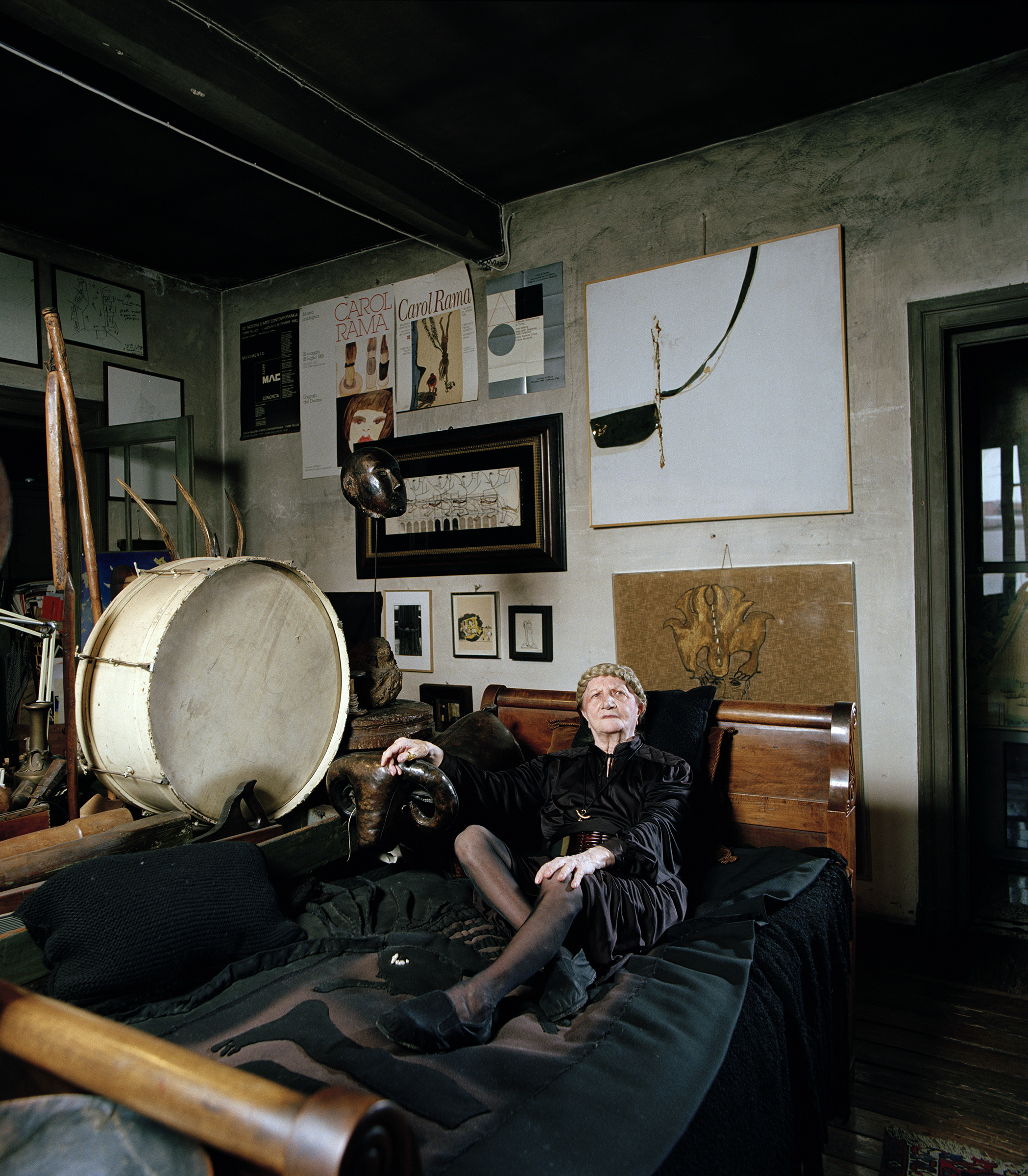
In contemporary times, many female artists have placed the female body at the center of their work: a political, militant, gendered, and often nonconforming body. In an avant-garde and entirely unprecedented way for the era, the body—with its carnal desires and fetishistic fantasies—is the main protagonist in the visual narrative of Carol Rama (Olga Carolina Rama, Turin 1918–2015), a desiring body that escapes the boundaries of the self disciplined by conventions. Precisely in the two decades when systemic patriarchy in Italy found one of its most fortunate alliances in fascism, this unconventional artist dared to represent women as shameless subjects of a voracious sexuality. This figurative obsession with bodies that defecate, masturbate, and stick out their tongues or expose their sex is, in fact, an obsession not to give up confronting morality, norms, and bourgeois, Catholic, and conformist respectability. Emblematic is the watercolor titled Appassionata (1940), in which a naked body, except for the shoes, lies on a hospital bed—or perhaps in a mental asylum—over which restraint belts hang. Here Rama makes manifest the map of repression and imprisonment suffered both by the body and the subconscious, the psyche when it does not align with the tracks set by the rules of its time. Each of her figures must therefore be considered not only as a representation of a body but as a “somatization” of political demands that, previously invisible and without status or legitimacy, finally gain their own critical voice as biopolitical apparatuses, precisely because of their difference.8
During the 1970s, the body became for female artists the privileged means of expression and struggle. It is precisely in the wake of the rediscovery of the political importance of sexual otherness that Suzanne Santoro (Brooklyn, New York, 1946) pursued her meticulous research on the representation of the female sex. An American by birth, the artist was in Rome at the end of the 1960s to study ancient sculpture; it was there that she began to investigate the cultural origins of the visual removal of the vulva in representations of female nudes throughout the history of Western art, emphasizing how the modest concealment or the trivialized and cursory depictions of female genitalia were the result of a specific cultural ideology—patriarchal and sexist—and not merely an artistic formalism. Suzanne Santoro conducts this investigation through a particular juxtaposition between the representation of the clitoris and natural, historical-artistic elements (such as details of classical drapery) or architectural structures capable of resonating formally with the appearance of female organs. This work fits within the broader context of the relationship between 1970s feminist art and photography; indeed, the realism of Santoro’s work, achieved through the photographic medium, perfectly corresponds to the ideological need for a reclamation of the female body and its natural processes, such as menstruation, pregnancy, and childbirth. In 1974, she published the artist’s booklet Per una espressione nuova / Towards a New Expression, which in its first edition still bore the title Rivolta Femminile (Female Revolt) on the cover. It is interesting to note that Santoro, in her work reconstructing the representation of the vulva, is aesthetically and culturally close to prehistoric depictions; on this point, Riane Eisler writes in her essay The Chalice and the Blade:
Numerous sculptures, among those that archaeologists call Venus figurines or Goddess figurines, as well as other ceremonial objects uncovered during excavations, feature strongly accentuated vulvas. Since prehistoric art primarily deals with myths and rituals, it is undeniable that these vulvas have a religious significance […] the vulva is also represented by symbols taken from nature, such as a flower bud or a cowrie shell. In fact, cowrie shells found among skeletons dating back over twenty thousand years indicate that the practice of placing these shells in burials [Cycladic, Editor’s note] as symbols of regenerative female power dates back to the most remote antiquity. The ancient Egyptians often decorated sarcophagi with cowrie shells, and even during the Roman Empire they were still considered a powerful symbol of regeneration and enlightenment.9
In the work of the verbo-visual artist Tomaso Binga (Bianca Pucciarelli Menna, Salerno, 1931), the female body once again becomes the ultimate political communicative tool because, unlike verbal language, it can express the specificity and exclusive belonging to female gender signs and meanings. In this case, the body becomes the instrument to dismantle the false naturalness of language, overturning it from a personal and situated point of view. An example of this are the Living Writings (from 1976), in which the artist has herself photographed nude while reproducing the shapes of alphabet letters with her body. In these photos, taken in the Florentine studio of her friend and Argentine artist Verita Monselles, the female body—real, flesh and blood, not abstract—is depicted at the moment it conforms to the linguistic and symbolic forms of patriarchal culture, which shapes its identity, while simultaneously creating a new gestural alphabet that symbolically stands as an alternative to the conventional one.
The body remains central to the work of American photographer Francesca Woodman (Denver 1958–New York 1981), analyzed especially from a formal and psychological perspective and according to a surrealist aesthetic. Woodman’s poetics are based on the constant overlap between the narrating self and the photographed subject: favoring self-portrait, self-shot, nudity, and intimacy, the artist incessantly investigates her own Self through the photographic lens. By positioning herself simultaneously as both object and subject, her work achieves a fundamental conceptual leap, breaking free from the grids of the male gaze and reclaiming her nudity and performativity. In her works, the body is therefore the instrument for self-representation, and the self-portrait a necessary analytical practice to understand her identity development: in this meticulous stylistic research that follows the directives of the body and nature, the camera is used as a tool of continuous self-analysis.
Although feminist theory has offered interpretive keys that are essential for understanding her work, Francesca Woodman was not a militant feminist. Her body is in fact conceived as a presence devoid of political intentionality; it is an element to be immortalized or hidden within the dilapidated spaces of industrial archaeology that she loved to use as unexpected theatrical backdrops on which to stage the often dreamlike and enigmatic representation of self-narrative.
In the artist’s shots, her own nude body becomes the means to represent its dissolution within the interiors it inhabits, disappearing among the tears of wallpaper or behind the doors of an old cupboard, thereby emphasizing—with its presence-absence—the elusive indeterminacy that permeates all her photographic work. Moreover, by positioning herself simultaneously as artist and subject, Woodman completely shatters the hierarchical order between model and painter, displaying a body certainly gendered but not provocative—a body of an angelic female, balanced between ecstasy and despair.
On the contrary, for the English artist Jenny Saville, the representation of the female body is monumental and overpowering. From an iconographic point of view, many of her compositions fall within the Renaissance pictorial tradition of the Madonna and Child, but with the purpose of overturning its meaning by removing outdated and stereotypical features. Her portrayal of motherhood is, in fact, detached from the culture of visual complacency, and the viewer, rather than remaining detached before an image of pure and abstract motherhood, is forcefully drawn into Saville’s canvases in an inextricable tangle of joy and pain—powerful, opposing, and contradictory emotions that constitute the experience of real motherhood. Her female body coexists with both pleasure and suffering, a body distorted beyond its usual boundaries by nine months of gestation. It is therefore the body of a great Mother, a deformed body that nonetheless reveals itself naked, disturbing compared to the idea of impossible aesthetic perfection conveyed by tabloids and advertising, and for this reason, majestic in its subversive power.
In this powerful painting, there can be no aseptic smoothness of form—certainly not in these bodies of flesh and blood pressing against other bodies made of the same matter. There is no place in these images, which exude effort and reality, for the false and dangerous idea of a pacified and smooth motherhood, that essentialist dimension that assumes motherhood as a necessarily happy stage. This idea again conceals the will to reaffirm the woman’s role and purpose within the system.
No longer hidden or constrained by the skirts and corsets of past centuries, Jenny Saville’s bodies have already undergone the political liberation of the 1960s but later found themselves prisoners of new rules, no longer related to morality but to appearance. Thus, thinness and youth remain the prison of Western women. As American feminist sociologist Camille Paglia10 emphasized in her controversial essay Sexual Personae, we have been portrayed as chthonic, curvaceous, and Dionysian; this “other” physicality of ours, which for centuries was far from being the measure of Apollonian perfection, is still often perceived as a burden or a stigma. Yet, at the very moment we courageously decide to show these bodies, we face the risk of objectification, of becoming prey.
Every woman’s relationship with her own body is a slalom between prescriptions, prohibitions, and induced desires, all cloaked in hypocrisy. Body-shaming is not politically correct, yet marketing, fashion, wellness culture, and the media continue to promote models of idealized and performative bodies. Children are considered too young to receive sex education, and yet the sexualization of their bodies and clothing, online exposure, and eating disorders have permeated childhood imagination for generations. What relationship can adolescent girls have with their bodies today, in a world where appearance is increasingly virtual and depersonalized? How can one practice acceptance of a real self if the filters on our phones and social media push the pursuit of an ever more uniform and standardized aesthetic perfection?
The challenge is to accept one’s own asperities or nonconformity in a world that has made smoothness its banner; a smoothness that, as the South Korean philosopher Byung-Chul Han writes, “is the hallmark of our time […] it is what unites the iPhone and Brazilian waxing […] smoothness does not hurt […] smoothness is the attribute of perfection, smoothness only wants pleasure, smoothness does not shake while a work of art causes a shock.”11 It is no coincidence that it is precisely the shock and the shaking we feel in front of Jenny Saville’s works that allow us to experience a profound and totalizing aesthetic, capable of opposing the proliferation of smooth images to be consumed quickly in a kind of anesthetized eternity.
What makes us perceive a body as beautiful, but above all, what is beautiful? “Qualities such as delicacy and elegance are considered beautiful. The body is elegant when it consists of smooth parts that show no roughness or confusion.”12 In the full Enlightenment, the English philosopher Edmund Burke13 distinguished between the beautiful and the sublime, placing the latter in a more complex and nuanced aesthetic category. Unlike the beautiful, the sublime may not evoke any immediate feeling of pleasure: it is an aesthetic vertigo placed on the uncertain edge between wonder and terror, like when observing a storm. This feeling, too overwhelming and too great for our imagination, already discussed by Pseudo-Longinus in his Peri Hypsous14, became central in eighteenth-century cultural debate: with early Romanticism, an aesthetics of sensitivity spread that shifted the process of enjoying a work from the object to the subject. Terms like “delightful horror,” “terrible joy,” or “pleasurable horror,” referring to natural phenomena or the great pictorial cycles of Renaissance masters, became the verbal codes with which to build the iconography of the Sublime. “Its entry into culture coincides with the overturning of classicist terms within which it had been interpreted until then: no longer connected to great taste and the grand style of ars dicendi or pingendi, it can reveal its effects only through an intensification and focus on what was already hinted at by Longinus, namely the association between terror and what remained of the Beautiful within its range.”15
Jenny Saville’s paintings can thus be fully classified within the category of the sublime because they lead us to that slippery edge where it is legitimate to assert, as the poet Rilke wrote, that “the beautiful is nothing but the beginning of the terrible.” Jenny Saville’s art is one that has not yet been forced into the corset of “likes”; it is an art that may not necessarily “make its viewers feel good,” but on the other hand, “art that makes one feel good is a contradiction in terms. Art must bewilder, disturb, unsettle, and even hurt; it must not be complacent […] complacency perpetuates sameness […] pain is instead the tear through which the completely Other breaks through.”16
The theoretical thought of Benni Bosetto (Milan, 1987) revolves around overcoming the rigid binary of man-woman combined with an anti-speciesist, trans-feminist, holistic, and spiritual vision of humanity and the planet it inhabits and resonates with. In their works, Bosetto investigates complex concepts such as the contrast and ambiguity between reality and fiction, between human and non-human, through the creation of evocative multimedia devices that combine drawing, sculpture, installation, and performance. This research shapes an original narrative situated between the dreamlike and the real, where it seems possible to experience a primary communicative dimension thanks to a preverbal language involving gesture and the body, which is central to the artist’s practice. Anthropology, art, magical thinking, and feminist philosophy intermingle to give life to grand theatrical representations, visually cathartic and dense with learned references, in a refined dance of light suspensions or drawings filling entire walls. Gathering stories and images from different and seemingly unrelated sources, the artist has created a personal iconographic and literary archive from which to draw in order to develop a purely subjective language. These narrative sources are selected through an essentially intuitive method and then transformed into “hyper-links” and “hyper-narratives” where ethnology, anthropology, legends, myths, news events, and religious beliefs are used as working tools, almost like a palette of colors.
The artist, who attended the dance academy of their hometown from age seven to thirty-two, has years of work on the body behind them, during which they experimented with its potentials and limits. It is therefore no surprise that the body often lies at the center of their powerful and imaginative narratives: a deconstructed, reimagined, and reinvented body, an assexual and enhanced hyper-body inhabiting a universe where the human is hybridized with other organic realities.
Their bodies are sensitive screens onto which the materialization of an imaginary world is projected, where politics, aesthetics, and philosophy merge in a post-anthropocentric and post-human vision. In Cleaning (2019), the large wall drawing made in a former clothing store room in Turin for the group exhibition Abstract Sex. We don’t have any clothes, only equipments, the artist imagined a “super organism populated by figures connected to one another by biomechanical tubes passing through their orifices. Engaged in communal healing practices, human meat banquets, or exercises of transformation and transition, they reveal the centrality of the body as a bastion of sensory wealth, the center of perception and affective intelligence, a source of material knowledge, and a repository of interpersonal and intergenerational memory.”17
The vision of this world suspended between reality and imagination takes us back centuries, particularly to the works populated by terrifying and fascinating human-animal hybrids created by the visionary genius Hieronymus Bosch; however, Bosetto simultaneously guides us toward a possible future where genetic engineering will have replaced biology. In Forss (2021), the wall-sized drawing created for the National Gallery of Modern Art, the artist presents a sci-fi story of a possible second life inside digital universes where the boundaries between human and non-human have completely fallen. Here too, the choice of hybridized and assexual human bodies is used to depict a different world where, as theorized by Rosi Braidotti, the concept of hierarchy among species and the singular and general model of man as the measure of all things is redefined.18
The process of sympoiesis enacted in Bosetto’s works — that is, the joining of reciprocal energies of biologies and activisms struggling for multispecies rebirth — inevitably recalls Donna Haraway’s concept of “making kin”:19 a term evoking human awareness of belonging to a common substance and thus the importance of establishing intimacy with all creatures of Earth, in a perspective of multispecies solidarity that employs inventive connections to live well and die well in the present, that is, in the epochs called the Anthropocene and Capitalocene: “generating kinships of unexpected nature. This means opening oneself to unexpected collaborations and combinations, being ready to be part of warm heaps of compost. We become-with each other, or we do not become at all... Individualism in its various scientific, political, and philosophical forms has finally become unthinkable to think: it is no longer a resource, neither technically nor on any other level.”20
- Maurice Merleau-Ponty (Rochefort-sur-Mer, March 14, 1908 – Paris, May 3, 1961) was a French philosopher and a leading figure of 20th-century French phenomenology. Starting from the study of perception, Merleau-Ponty concluded that the body is not merely a thing, a potential object of scientific study, but is also the necessary condition for experience: the body constitutes the perceptual opening to the world. So to speak, the primacy of perception means a primacy of experience, insofar as perception plays an active and constitutive role. The development of his work establishes an analysis that recognizes both a bodily dimension of consciousness and a kind of intentionality of the body. This argument stands in clear contrast with the dualist ontology of body-spirit categories proposed by René Descartes (a thinker who holds a particular importance for Merleau-Ponty, despite the evident divergences that separate them). Merleau-Ponty then begins a study of the individual’s embodiment in the world, seeking to overcome the alternative between pure freedom and pure determinism, as well as to bridge the gap between the body-for-itself and the body-for-others. Both his work on corporeality and on language reveal the importance, for understanding expressivity, of the individual’s rooting at the heart of the lived world. Or rather, this rooting includes the dimensions of historicity and intersubjectivity, which he strives to make intelligible. The fundamental philosophical problem for Merleau-Ponty is that of the human being’s relation to the world in its totality, as both nature and as otherness reflected within oneself. The human being is a consciousness embedded in a whole, and the relationship between the self and the whole is the existential horizon within which the French philosopher positions himself. ↩︎
- Gian Paolo Terravecchia, Merleau-Ponty e la carne come perno del mondo, in "La Ricerca", 2021. ↩︎
- Cfr. Susan Brownmiller, Femminilità, Feltrinelli, Milan, november 1985. ↩︎
- Ecofeminism supports the existence of a parallel between the subordination of women and the degradation of nature, based on the theory that ideological hierarchies allow society to systematically justify the domination (“power-over power”) exerted by subjects classified in higher-ranking categories over those classified in lower-ranking categories—for example, men over women, culture over nature, white people over Black people. Ecofeminism aims to investigate the intersections between sexism, domination over nature, racism, speciesism, and other forms of social inequality. Some ecofeminists have argued that the capitalist and patriarchal system expresses a triple domination of developing countries, combined with the exploitation of women, resource-poor peoples, and nature. ↩︎
- Leonardo da Vinci, around 1490. ↩︎
- The Malleus Maleficarum is a Latin treatise published in 1487 by the Dominican friar Heinrich Kramer, with the collaboration of his fellow friar Jacob Sprenger, aimed at suppressing heresy, paganism, and witchcraft in Germany. ↩︎
- Cfr. Riane Eisler, Il piacere è sacro. Il potere e la sacralità del corpo e della terra dalla preistoria ad oggi, ed. FORUM, Udine, 2012, pp.62-63. ↩︎
- Cfr. Paul B. Preciado, "The phantom limb. Carol Rama and the history of art”, in The Passion According to Carol Rama, catalogo della mostra, Musèe d’Art Moderne de la Ville de Paris, 2015, pp.27-28. ↩︎
- Riane Eisler, Il piacere è sacro. Il potere della sacralità del corpo e della terra dalla preistoria a oggi. Edizioni FORUM, Udine, 2012, p.54. ↩︎
- Emily Dickinson, Turin, Einaudi, 1993 – first edition 1990, Yale University Press. ↩︎
- Byung-Chul Han, La salvezza del bello, Nottetempo, Milan, 2019, pp.9-15. ↩︎
- Ivi, p.27 ↩︎
- Edmund Burke (1729–1797), a British politician, philosopher, and writer of Irish origin, was one of the main ideological precursors of English Romanticism. ↩︎
- On the Sublime, in Greek Περὶ ὕψους, is a treatise on aesthetics dating back to the early second half of the 1st century AD ↩︎
- Massimo Carboni, Il Sublime è ora. Saggio sulle estetiche contemporanee, Rome, Castelvecchi, 1993, p.15. ↩︎
- Byung-Chul Han, La società senza dolore. Perché abbiamo bandito la sofferenza dalle nostre vite, Turin, Einaudi, 2021, pp.10-11. ↩︎
- Benni Bosetto, profile written by Michele Bertolino, in Fuori, collective exhibition catalogue for the Quadriennale d’Arte, 2020, Palazzo delle Esposizioni, Rome, Treccani, October 30, 2020 – January 17, 2021, p. 144. ↩︎
- Cfr. Rosi Braidotti, Il Postumano. La vita oltre l’individuo, oltre la specie, oltre la morte, Derive e Approdi, 2014. ↩︎
- Although lacking an equivalent in the Italian language, Kin means “blood relative,” “kin,” “lineage,” and “descendance.” For a deeper understanding of the concept of Kin, see Adele Clarke and Donna Haraway, Making Kin: Fare parentele, non popolazioni, DeriveApprodi, Rome, 2022 ↩︎
- Donna Haraway, Making Kin. Fare parentele, non popolazioni, DeriveApprodi, Roma, 2022, pp.13-18. ↩︎