
"We are made of heart and brain, no AI can replicate us"
She heard the beep-beep of Sputnik on the radio, used punched cards on one of the first computers in Italy, and designed instruments that travel through space. Born in 1937, the first woman in Italy to graduate in Aeronautical Engineering, Amalia Ercoli Finzi enrolled at the Polytechnic University of Milan at a time when the only acceptable career path for a woman seemed to be teaching. Over the course of her professional life, she collaborated with the European Space Agency and led, for the Rosetta mission, the design of the instrument that in 2014 drilled into the surface of comet 67P. Now professor emeritus at the Polytechnic University of Milan, she has lived through nearly a century of technological innovation: from the space race to the age of artificial intelligence, which she observes today with the same curiosity that has guided her entire career as a scientist.
Professor Ercoli Finzi, your parents wanted you to become a Mathematics teacher. Instead, you chose to graduate in Aeronautical Engineering at a time when women in that faculty could be counted on one hand. Why did you make that choice?
At that time, even enrolling in a Mathematics degree was considered a forward-thinking choice: in theory, I should have become a primary school teacher like my mother, because that was seen as a woman’s job. But things went differently thanks to my Maths teacher, who was a religious man. He told my family: «This girl must attend a scientific high school», and they listened to him. At that point, I was expected to become a Maths teacher, but I wanted to do something that would help me understand how things work. I wanted to grasp the mechanisms that turn energy into motion or a pile of bricks into a house. I was very curious, and that curiosity has stayed with me throughout my life. Even today, after so many years, I remain eager to discover the world.
There were very few women in that faculty…
Yes, enrolling in Aeronautical Engineering at the Polytechnic University of Milan was an absolutely extraordinary choice, it was the most technologically advanced field at the time. There were five women out of 650 men, and all five of us graduated. We looked like rare birds, and in the first year our classmates had no confidence in our abilities. I remember that during lectures they kept explaining and re-explaining things to me that I had already fully understood. Then, when the summer exam session began, I got top marks with honors in Analysis 1, Geometry 1, Chemistry, and Physics. Only then did they finally realize that I understood things perfectly well, and from that moment the paternalistic attitude turned into a relationship based on respect.
After that, did you experience any discrimination related to being a woman?
As long as I was at the Polytechnic University, I experienced almost no gender-based discrimination and I felt very comfortable. The problems came later, when I entered the world of research. In a scientific career, gender matters: to get where I am today, I had to work much harder than many of my male colleagues who were less capable than me. I became associate professor, then full professor, department director, and now professor emeritus. In short, I did everything I was supposed to do.
Over the years, have you seen improvements in the situation of women in scientific research?
My daughter, who worked in the industrial sector, faced more difficulties than I did. When I became pregnant, the Polytechnic University simply found a replacement for a few months. But forty years later, when my daughter returned to work after maternity leave, she found herself without any projects to work on. They had taken everything away from her. Today, many young women still face many challenges. It’s no coincidence that when I was president of the Equal Opportunities Committee at the Polytechnic University, we managed to establish the only university daycare center currently existing in Italy. In my opinion, this is the right way to support working women, regardless of whether they are researchers or administrative staff. With a daycare center, absenteeism among women decreased. They could go to work even when their children were not in perfect health, because they knew that if something serious happened, they would be called. A daycare center is worth more than a financial incentive or a bonus. It allows you to manage your time with greater autonomy.
Does this mean that, paradoxically, as more women enter STEM professions, the situation has worsened instead of improving?
That’s exactly the case: we give birth to children, while men continue to “reproduce themselves” in positions of power. It is their prerogative. A man is replaced by another man, especially in those decision-making roles that would be crucial for us, because that’s where choices are shaped and real impact can be made. When we are excluded, we can only adapt to decisions made by others.
You have lived through nearly a century of innovation, from the space race to the era of artificial intelligence. Looking at your experience, what strikes you most about this new technological phase?
My life has unfolded alongside history. I remember June 6, 1946, when I read in Corriere della Sera: «The Italian Republic is born». I was nine years old, and it was the first time women voted. We, women graduates, gained the right to vote 40 years after illiterate men: a paradox that says a lot about the country at the time. After the birth of the Italian Republic, I witnessed the beginning of space exploration: I enrolled at the Polytechnic University of Milan in 1956, and the following year Sputnik was launched into orbit, the first artificial object to circle the Earth. I remember it well: I heard its beep-beep on the radio. And yet, if I think about the innovations that truly changed the world, the most disruptive was the computer. The first computer to arrive in Milan was purchased with Marshall Plan funds: it landed in Genoa by ship and was then transported by truck to the Polytechnic University. I worked with the punched cards that were used at the time to perform the first calculations. The computer changed the world by making global connection possible. You press a key, and someone on the other side of the planet receives your message. Without that breakthrough, we would not have witnessed such rapid and impressive technological development. Many of the things we now take for granted were achieved little by little.
What was the main reaction to the arrival of computers and automation? Can that mindset help us better understand today’s fears?
People were terrified: «Where are we going?», they would say. I remember a priest warning the assembly during a sermon: «There is no more religion, we are heading toward the end of the world». Even then, there was fear that machines could replace human beings. At the time, there was only the typewriter, and people wondered: «Will we start writing letters with a computer now?». We tend to fear that technology may harm human beings, but the opposite is true. Machines have reduced hard, labor-intensive work. When the washing machine was first exhibited at the Milan fair in 1946, people were afraid that washerwomen would lose their jobs.
In space missions, automated systems operate millions of kilometers from Earth, without human intervention in real time. AI systems also make autonomous decisions in critical areas. What distinguishes the autonomy of a space probe from the autonomy of artificial intelligence?
The autonomy of spacecraft is always designed in advance to minimize human intervention. Before sending them into orbit, we program satellites to make autonomous decisions based on the parameters we provide. Above all, we try to implement recovery systems, meaning we anticipate possible failures and design ways to fix them automatically. This is what we did with missions such as Cassini-Huygens, where we predicted all the possible malfunctions that could occur over the distance between Earth and Saturn. Artificial intelligence, on the other hand, is a more sophisticated system that imitates the processes the brain uses to make decisions. Computation is structured through neural networks, which later evolved into so-called learning machines, systems capable of learning. We teach the machine to reason autonomously, choosing among two, three, or five possible options the one that, under given conditions, requires less energy or can be reached more quickly. Once the context is defined, the machine makes a choice based on the parameters we have provided. So, a satellite acting autonomously is entirely programmed by us, whereas artificial intelligence makes its choices based on what we have taught it.
AI promises to replace or transform many professions. Workers from different sectors are concerned, if not openly alarmed. Do you share this concern?
As a naturally optimistic person, I believe that artificial intelligence can be a form of support. It is important to see it for what it is: a loyal servant, at the service of human beings, especially women. For someone like me, who has spent a lifetime solving equations, its arrival represented a real shift in mindset. In my field, equations are the fundamental tool, the logic that allows us to predict the future. But artificial intelligence proceeds differently: it gathers data, numbers, and information and, through algorithms, identifies correlations, similarities, and patterns. When I think about it, it makes me smile, but initially artificial intelligence was used by insurance companies. By analyzing large volumes of accident data, it was possible to discover, for example, that in a small town in Sicily there were far more accidents than expected given the number of cars in circulation. This kind of evidence only emerges when millions – sometimes billions – of data points can be processed. It is the mathematics of large numbers: a different logic from the one we apply to a single case. It is like comparing the behavior of an individual person with that of a crowd. An individual may be calm and reasonable, a crowd can turn into a raging beast.
So AI is not a neutral tool?
The problem is that the data we have available are often partial. For example, the Italian population is largely white, there are relatively few Black people. If systems are trained on these data, the results will not be fully generalizable, because the initial sample is limited and does not represent humanity as a whole. The same applies to algorithms, which are built by us and carry our biases. If those who design them believe that Black people – women in particular – are more dangerous to society, that bias will enter the system, producing effects on millions of people. This is where the ethical challenge lies. There are organizations that analyze algorithms developed by major tech players such as Google or Amazon, identify errors and distortions, and report them. That is what needs to be done. This makes me optimistic, together with another consideration: the results of traditional mathematics, those based on equations, can also feed AI databases. And that is what we are doing at the Polytechnic University of Milan. That is why I am not afraid of artificial intelligence. I am more concerned about the people who work on it: their mistakes become errors on a global scale, capable of affecting entire segments of the population.
All of this brings us back to a fundamental question: is there a structural difference between how the human brain works and how artificial intelligence operates?
So far, we have talked about equations and data, but our brain uses two different mechanisms depending on the task. For example, when it sends a command to an arm to move, it operates according to a logic that can be traced back to classical mechanics. When it has to make a decision, however, another dimension comes into play: no longer deterministic, but probabilistic. This depends on scale: neurons are extremely small structures and, at that level, the laws of physics change. It is a huge leap. We no longer say that two plus two equals four, but that it is probable that two plus two equals four. The world of the very small – electrons, neurons, particles – enters human behavior and changes its logic. Moreover, artificial intelligence must also take relativity into account. A concrete example shows this: GPS. That satellite system works so well precisely because its calculations incorporate relativity. Without it, navigation would not be reliable. This is why “artificial intelligence” is such a vast, all-encompassing expression. It contains everything: new mathematics, new mechanics. And within this whole, inevitably, there is also room for our biases, our misconceptions, and our errors.
One final question: Professor, what must we make sure never to delegate to machines?
What we will never be able to delegate is our deepest specificity. We are not made only of a brain: we also have a heart. It is the interplay between logic and feeling that allows us to perform actions and make choices that neither dimension alone could produce. In 1977, the Voyager probes were launched to explore the great planets of the solar system: Jupiter, Saturn, Uranus, and Neptune. A few years later, Carl Sagan, the planetary scientist who had designed the mission, made an unusual request to NASA. The probes were traveling into deep space with their antennas pointed outward. Sagan asked to turn them 180 degrees to photograph the planets left behind. No one else would have been granted such a request, but Sagan was Sagan, and NASA agreed. In that photograph, you can see the Earth. It is just a tiny dot. In the solar system we carry no weight, let alone in the universe. And yet, on that tiny dot, a miracle has occurred: a living reality has emerged, capable of uniting brain and heart, logic and love. A love understood broadly, for nature, for animals, for children, for older people. This union is what defines us. And it is something no artificial intelligence will ever be able to replicate.
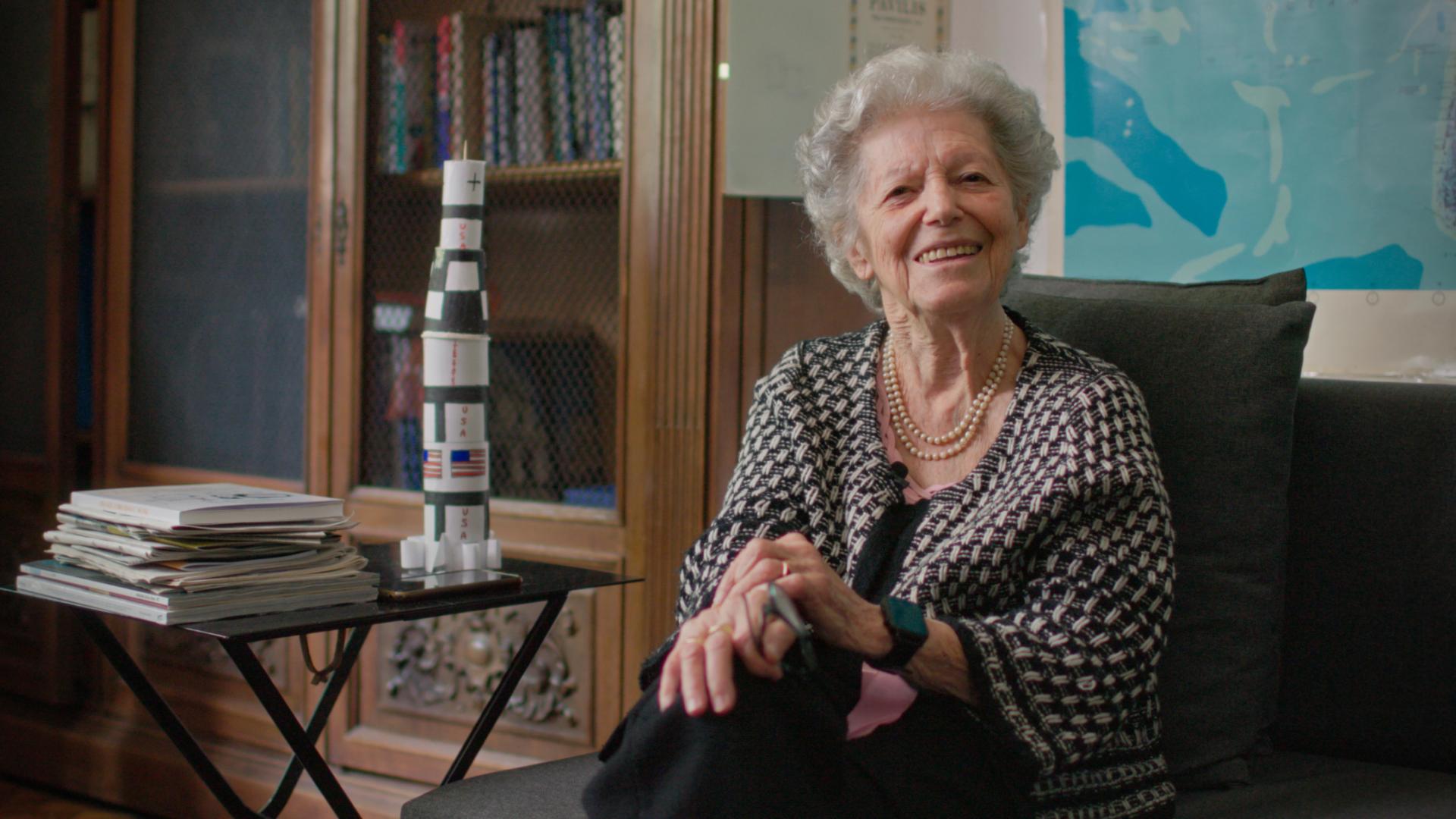
In the photo, Amalia Ercoli Finzi during the filming of Generations