
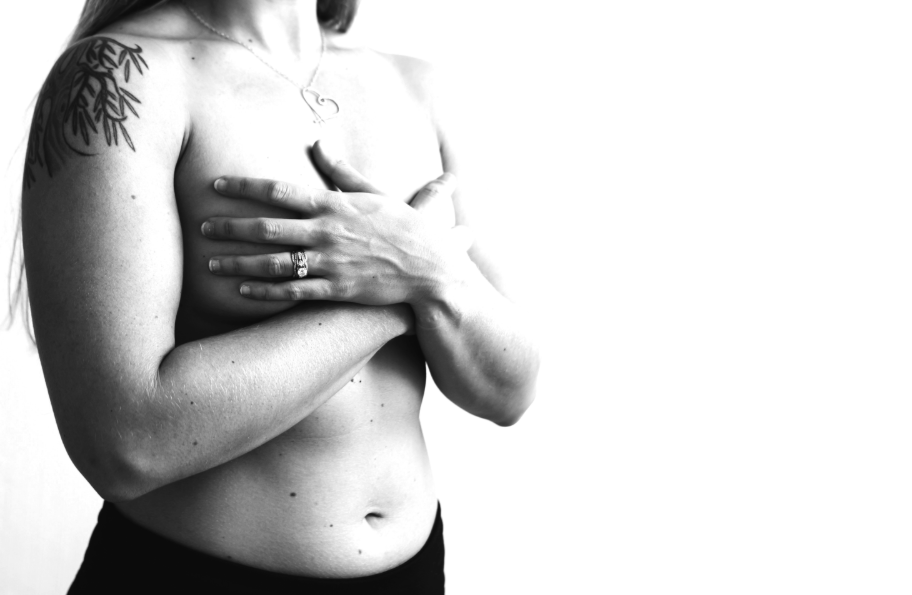
The body
Saturday, April 24.
“I’m sorry, ma’am. Contrary to what we expected—and hoped—the biopsy revealed cancer cells. Unfortunately, you fall within that 2% of cases where this happens.” I feel dizzy. I think I’m going to fall off the chair. I cling to the doctor’s desk. What now? The breast specialist is truly excellent: he explains everything clearly, speaks with my husband and my mother, reassures me, and immediately schedules an appointment with the oncologist.
Six hours later, after endless crying, “Are you scared?” Maurizio asks me. “Yes,” I answer. “And you?” “Yes,” he says, and for the first and only time throughout the whole illness, he admits: “I’m afraid of losing you and being left alone.” At that exact moment, I decide that no, I would not leave him alone—not two months after our wedding on a snowy Saturday in February, stubbornly planned despite the Covid restrictions simply because we didn’t want to postpone it any longer. “I’ll do whatever it takes to get better, I promise,” I tell him—my own personal whatever it takes to reassure us both.
That is where my journey into illness begins, into my body, with my body. I understand it immediately. My mind and I are clear-headed, ready; it feels as though nothing has changed. There are so many plans ahead of us: the honeymoon, the celebration, life itself. But my body says otherwise. It carries out its great betrayal. It stops me there, having decided without consulting me. It created an intruder, cell by cell, and now I will have to endure the consequences.
Monday, April 26.
Tower 6, Papa Giovanni XXIII Hospital in Bergamo. If I am here today, it is thanks to science, to the doctors and nurses who somehow manage to balance professionalism, rigor, and relentless schedules with humanity, empathy, and the need to listen to patients. I don’t know how they do it. But my body is taken hostage almost from the very first day. I consider this yet another aggravating factor in the betrayal… I can no longer choose.
April, May, June, July, August, September.
Everything—the rhythms, the treatments—is aimed at healing. In theory, everything is fine. In practice, it is not. I have to eat certain foods (or avoid others). I have to exercise even though that nausea rooted deep in my bones never leaves me. I have to be either full or fasting depending on the treatment. I have to drink, and for some reason I now hate water, so broths of every kind begin appearing around the house. I have to lose my hair. “Will I need chemotherapy?” I had asked immediately. “Yes, it’s necessary for your type of cancer. You will lose your hair, I’m sorry.” “Can anything be done about it?” I ask. “No, but hair grows back. Let’s stay focused on what matters.” At that moment it feels like a terrible injustice (and it is).
My hair begins its autumn and winter—which become mine as well. The first strands fall onto my laptop keyboard after two days of intense scalp pain. Just one infusion of “the red one” is enough. So I decide. Alone with Ilaria, my hairdresser, we cut it all off one Saturday morning. Two rounds of scissors and one with the clippers, nearly an hour. By then, Dead Cat—as I call the wig—has already arrived at home. Ilaria teaches me how to wear it, trims the bangs, adjusts the strands. Wearing it to the supermarket is the first trial by fire. Taking it off and showing myself to Maurizio and my mother is another matter entirely. “You’re still you,” my mother tells me through tears. “Of course,” I reply, though I am not convinced at all.
Dead Cat and I eventually begin to get along. She is brunette and short, and my mother carefully washes her every week. What I dislike instead is the fuzz my head stubbornly keeps growing. So every Saturday, with patience and menthol shaving foam, Maurizio shaves my head. If I have to look like this, I want to do it properly. Sometimes I don’t recognize myself. Sometimes I notice a resemblance to Uncle Fester that is not exactly subtle, and it makes me furious. I confess this to a friend, who provocatively asks: “Would you rather look like Cousin Itt?” No, I don’t think so.
For six months, I belong entirely to the people treating me. My days revolve around therapy sessions, sometimes accompanied by Maurizio, sometimes by my friend Enrica. At night I read because I cannot sleep. Thankfully, work keeps me connected to ordinary life. I thought about it a lot afterward. Could I have done something differently? Instinctively, I think yes—but then I can’t really say what. Maybe not living through those months holding my breath, head down, asking no questions in order to keep fear under control. Maybe letting go a little, trying to negotiate some concessions with my old life.
November.
Chemotherapy is over, surgery is behind me, but that thin wound—stitched closed by a woman—fills me with profound discomfort. “I can’t look at myself in the mirror, and I can’t touch the scar,” I keep telling Elena, who helped me heal many wounds. “That scar is your jewel. You must wear it with pride—it is the mark of your strength,” she says. “Be grateful to your body for always supporting you. Stop asking yourself why.” For the first time, I begin to wonder whether it wasn’t betrayal after all, but rather a tsunami that swept over me and against which nothing could have been done. There is no reason. There is only a fact.
December.
After nine months, I taste milk chocolate again. My nails have turned dark, and nail polish is discouraged because it could damage them even more. But my body and I decide that no, my nails will not be ruined, and the polish comes back—disappearing punctually the day before each check-up. The fuzz on my head thickens; I stop cutting it, and I no longer resemble a sad peach. I buy shampoo again; it becomes my own private celebration in the shower. Then there’s the blue mascara that promises to turn those tiny little hairs into doll-like eyelashes.
February.
I undergo radiotherapy while positive for Covid. By now, the staff in the department and I joke about it. “You really don’t miss out on anything,” they tell me. I almost talk to that sort of UFO robot that rotates around me and at a certain point opens its mouth to release the stream of radiation. It is the final major step. I think: “I’ll be free. I’ll go back to doing whatever I want.”
I’ve gained quite a bit of weight. Maurizio encourages me to choose new clothes; he has not stopped supporting me for a single moment since all this began. I try on a pair of white jeans almost by chance. They are soft, bright, enveloping. They fit me well, and I can’t believe it… I feel like crying (and I do) right there in the store, in front of the mirror I had feared for months. The sales assistant cries with me when I explain why.
April, one year later.
Everything begins to return, though not in the way I expected. I am myself, and yet I am no longer myself. Those months carved new paths inside me, sometimes winding and stony, like the beds of certain rivers. I have three tiny dots on my chest, three miniature tattoos arranged in a triangle that were used to guide the radiotherapy machine. They become my personal constellation. Sometimes I look at them again and again, trying to understand who I have become. Today I think about it almost every day, but that’s okay. By now, those thoughts have lost most of their sharp edges. I recognize myself. I inhabit my body with awareness; I listen to it. Sometimes we still quarrel, but most of the time we stand together, and we speak to each other—literally. She, the scar, is still there… and that’s okay. It is not yet a jewel, but I cannot rule out that one day, perhaps in the dim light before the mirror, I will see it shine.