
Protecting memory means protecting justice
Dear Nagham, first of all, I would like to introduce you to our readers. Who are you? Tell us about yourself, your family, how you became a journalist, and what you were doing regularly up until October 7, 2023.
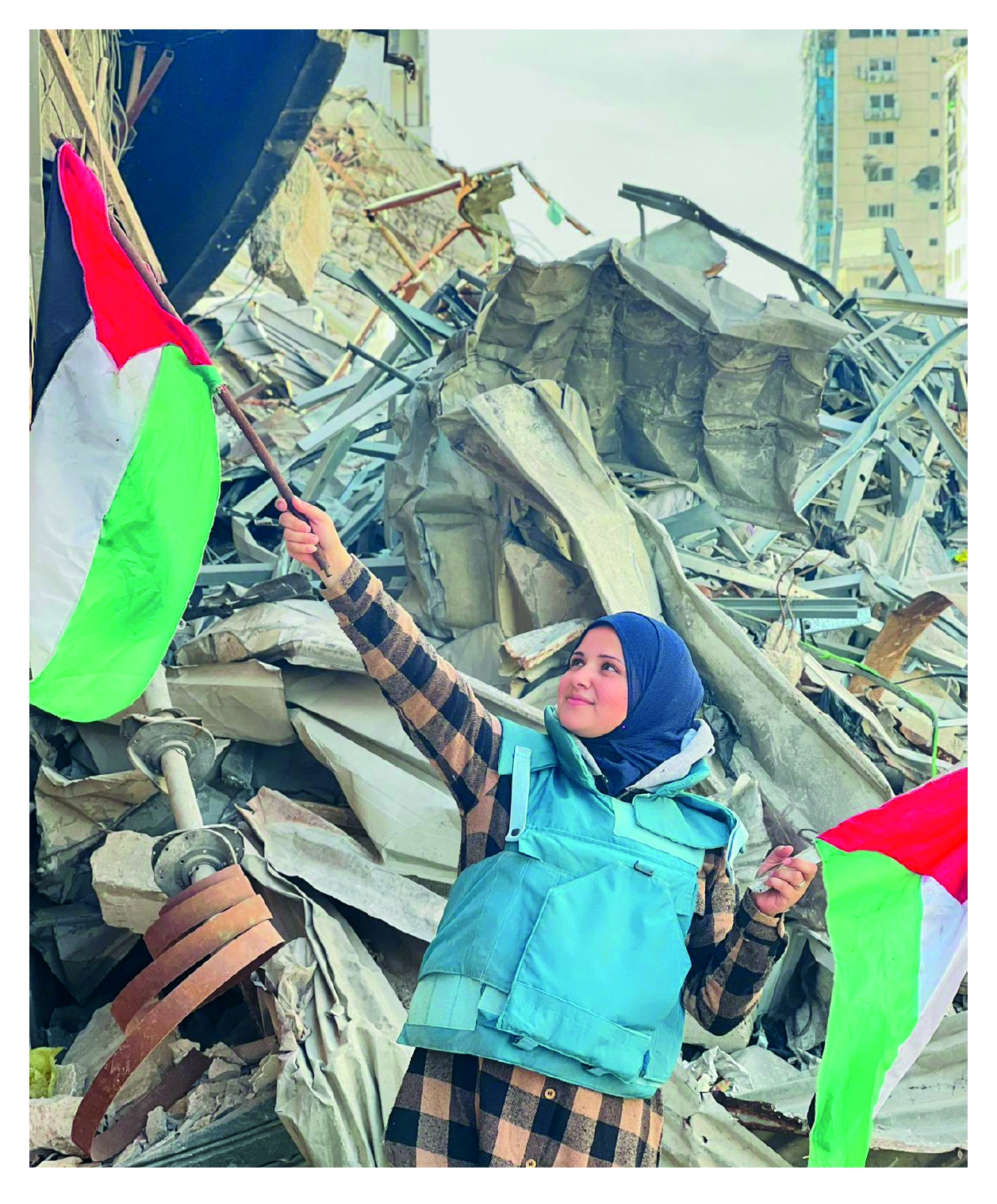
My name is Nagham Karaja. I am Palestinian and an independent journalist from Gaza. For the past nine years, I have worked in both print and audiovisual journalism, producing investigations, reports, and multimedia content documenting the lives of Palestinians. Throughout my career, I have devoted much of my work to women and children because I believe they are among the most vulnerable members of our society, especially during times of conflict. My journalism has always sought to give a voice to those who too often go unheard and to tell the human stories hidden behind news headlines. I am also Ahmed’s wife and the mother of three wonderful children: Amir, Amjad, and little Ayla. Before anything else, I am a mother trying to protect my children while documenting one of the most devastating periods my community has ever experienced. Before October 7, 2023, my work focused on women’s rights, children’s rights, human rights, and gender-based violence. I collaborated with local and international journalism organizations, convinced that journalism is not only about reporting facts, but also about preserving memory and defending human dignity. As has happened to many journalists in Gaza, the war has profoundly changed my professional life. During an intense bombardment of the residential area where I lived, I was injured in the foot. Because of the collapse of the healthcare system and the severe shortage of medical supplies, I was unable to receive adequate treatment for nearly seventy days. The injury prevented me from moving around and working for a long period, and I lost the journalistic assignments and collaborations I had worked so hard to build over the years. It was one of the most painful consequences of the war, not only because I was injured, but because I suddenly found myself separated from the work that had always given meaning to my life. Looking back on that journey today, I realize that those nine years of journalism had prepared me to document one of the greatest humanitarian crises of our time. What I could never have imagined was that one day I would become part of the very story I was trying to tell.
You live and work in Gaza. What is a typical day like for you? What does it concretely mean to live, raise three children, and do your job in a place that the rest of the world knows almost exclusively through images of war?
There is no longer such a thing as a normal day. Every morning begins with the same questions: Will my children have something to eat today? Will we find clean water? Will we still have somewhere to sleep tonight? These are the realities that shape every decision I make, even before I think about journalism. I am raising my three children in circumstances that no family should ever have to experience. Like thousands of other people, we have endured repeated displacement and constant uncertainty. And yet life does not stop. Children still need comfort, reassurance, and moments of joy, even in the middle of war. At the same time, I continue to work as a journalist. Sometimes I leave my children to interview families in hospitals, shelters, or displacement camps, knowing that there is no guarantee I will make it home safely. Other times, I carry my notebook with me while searching for food, water, or medicine for my family. The world often sees Gaza through images of destruction. I see something else as well. I see mothers sharing their last piece of bread with their children, neighbors helping one another despite having almost nothing, and children still finding a reason to smile, even among the rubble. Perhaps these moments will never become front-page news, but they tell the deeper truth about Gaza. My responsibility is to make sure they are not forgotten.
How do you remain a journalist when you are also part of the story you are telling? What are the greatest responsibilities of someone who is also reporting from a war? How do you decide what to tell?
This is a question I ask myself almost every day. I am not telling a war story from a safe distance. I am living it. Like the people I interview, I too have experienced fear, displacement, loss, and uncertainty. During the war, the residential area where I lived was hit by intense bombardment. As I mentioned, I was injured in the foot, and that experience changed me forever. It reminded me that I was no longer simply documenting other people’s suffering: I was living it too. Some people believe that this makes it more difficult to remain objective. I believe it makes me more responsible. I understand the weight of every testimony because I know what it means to fear for your family, to lose your sense of security, and to wake up every day without knowing what tomorrow will bring. When I choose which stories to tell, I ask myself a very simple question: if I do not tell this story, who will remember this person? Statistics are necessary, but numbers cannot cry, dream, or leave memories behind. People can. My role is to make sure they are remembered not as numbers, but as human beings with a name, a family, hopes, and a life that mattered.
Your reports focus above all on women, children, families, and everyday lives. Will they also be your main focus in the stories you write for DiverCity?
Wars are often told through military operations, political statements, and casualty figures. But behind every newspaper headline there is a person whose life has been changed forever. For me, women, children, and families are not secondary stories. They are at the heart of every conflict. Women carry an enormous burden during war. They become caregivers, financial providers, and protectors of their families while facing grief, displacement, and unimaginable loss. Children lose far more than their homes: they lose their routines, their schools, their sense of security, and, very often, their childhood itself. These stories matter because they remind us that war is not fought only on battlefields; it is lived every day in homes, hospitals, shelters, and tents. As a journalist, I believe my responsibility is not only to document destruction, but also to preserve humanity. Every interview I conduct is an attempt to ensure that someone’s voice is heard, that someone’s memory is preserved, and that someone’s suffering is not reduced to a mere statistic. That is exactly what I hope to bring to DiverCity. I would like readers to get to know Gaza through its people, not only through images of devastation, but also through the stories of mothers raising their children in impossible circumstances, young people refusing to give up on education, families supporting one another despite having almost nothing, and people who continue to dream while living through war. Because behind every conflict there are ordinary people whose dignity deserves to be seen, respected, and remembered.
Is the status of journalists in Gaza in any way protected today? Are there any guarantees or forms of protection that you can still rely on?
International humanitarian law recognizes journalists as civilians who should be protected while carrying out their work during armed conflicts. Unfortunately, the reality in Gaza is very different. Today, a press vest, a helmet, or a camera offers no real protection. Many journalists have been killed while documenting events; others have been injured, displaced, or have lost family members, colleagues, and their homes. Newsrooms have been destroyed, equipment has been buried beneath the rubble, and even basic communications have often become impossible. Every time I leave home to report, I know there is a possibility that I may not return. My husband knows it. My children know it too, even though they are too young to truly understand what it means. Perhaps this is the most difficult part of my work: not the physical danger itself, but the fact that every assignment means saying goodbye to my family without knowing for certain whether I will see them again. And yet I continue. Not because I feel protected, but because I believe silence is even more dangerous. If journalists stop documenting what is happening, countless lives risk disappearing without leaving any witnesses behind. Our cameras may not protect us, but they protect the truth. They preserve memory. They ensure that the experiences of ordinary people are not erased from history.
Is there something you fear might be lost forever? And what do you believe is still worth defending, at any cost?
I fear that an entire generation of Palestinian children will grow up without knowing what a normal childhood looks like. I fear they will remember the sound of bombardment more clearly than the sound of a school bell, and that memories of displacement will replace birthdays, family gatherings, and those ordinary days that every child, everywhere in the world, should be able to experience. I also fear that homes can be rebuilt, but that the feeling of home may never fully return. Neighborhoods can disappear, family photographs can remain buried beneath the rubble, and entire communities can lose the places that shaped their memory and identity. But perhaps what I fear most of all is that the world will become accustomed to our suffering; that people will stop being outraged, stop asking questions, and eventually stop listening. Despite everything, there are things that must always be protected: truth, memory, and human dignity. These are the foundations of every story I tell. As journalists, we cannot stop wars, nor can we rebuild what has been destroyed. But we can preserve people’s voices. We can leave behind an honest record of what happened, so that future generations will know that behind every statistic there was a human being who loved, dreamed, hoped, and deserved to live. For me, protecting memory is also a way of protecting justice.
This issue of DiverCity is dedicated to pride. After everything you have experienced and continue to experience, what does this word mean to you today?
Today, the meaning of the word “pride” has completely changed for me. It is no longer about awards, recognition, or professional success. Pride is waking up every morning and choosing hope over despair. It is looking into the eyes of Amir, Amjad, and little Ayla and finding the strength to smile even when fear lives inside me. It is continuing to be a mother while carrying the responsibility of being a journalist on my shoulders. It is leaving my family to document someone else’s pain, trusting that I will return safely and believing that every story I tell has value. Pride is refusing to let war take away my humanity. It is believing that compassion is stronger than hatred, that truth is stronger than propaganda, and that hope is stronger than fear. I do not know what tomorrow will bring for my family or for Gaza. But I know that as long as I can hold my notebook, ask difficult questions, and tell people’s stories with honesty and dignity, then the war will not have succeeded in taking away who I am. Finally, I would like to express my deepest gratitude to the entire DiverCity team for believing in my work and for choosing to give space to my voice in this issue. At a time when so many voices from Gaza struggle to be heard, this collaboration means much more to me than a professional opportunity. It is an act of trust, solidarity, and a reminder that our stories still matter. I sincerely hope that this is only the beginning of a long and meaningful collaboration, through which we can continue bringing the human stories of Gaza to readers around the world. Because buildings can be destroyed, streets can disappear, and lives can be changed forever. But as long as someone continues to tell the truth, memory will survive. And sometimes, memory is the strongest form of justice we can leave behind.