
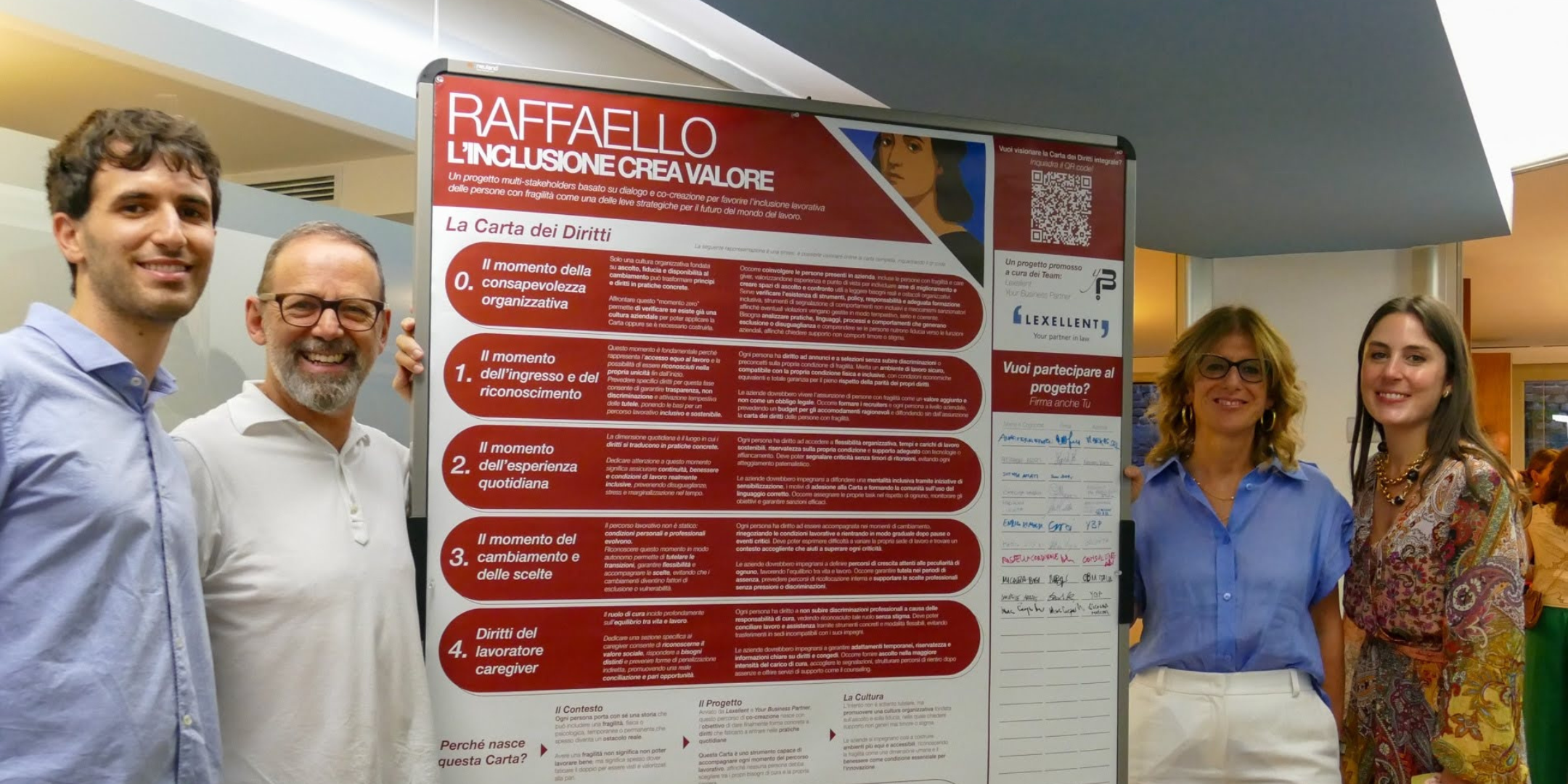
People with vulnerabilities: a universal card for inclusion
How was the Raffaello Project born, and what prompted you to turn its vision into a Charter of Rights for people experiencing vulnerabilities and caregivers in the workplace?
GB: The project grew first and foremost out of our twenty-year friendship, but personally I had already been thinking for some time that a different approach was needed towards people with disabilities and vulnerabilities in the workplace. Maria Rosaria and I said to each other: “Let’s sit around a table and try to analyse the issue.” And so, in October 2025, the Raffaello Project was born. The initial idea was to organise a launch event exploring disability in the workplace from legal, organisational and personal perspectives. But the project then evolved into discussion groups on vulnerability, bringing together experts and members of our teams who could contribute their perspectives. We subsequently continued organising these discussions remotely with companies, which also brought in the lived experiences of people experiencing vulnerabilities. Working on corporate culture therefore became a need expressed directly by the organisations themselves, and that is when we realised that a Charter could be a useful tool.
MRN: I was particularly struck by the enthusiasm we received, especially during the initial October workshop on inclusion as a strategic lever for creating both personal and economic value for companies. At the heart of the discussion were patients, caregivers—figures who are often overlooked—and how supporting people experiencing vulnerabilities can generate both economic and human growth for companies. It was a collaborative, enriching and inspiring journey.
What was the most challenging aspect of drafting the Charter? And what kind of response did you receive?
GB: The Charter emerged naturally from the process, so there were no particular complexities to overcome. The most difficult aspect was a personal one, because we were afraid people might not support us, or might think: “Oh yes, this will just be another marketing exercise.” The challenge was not creating the Charter itself, but keeping people engaged throughout the entire process and making sure we did not lose anyone along the way. When we sent out the final version of the Charter, we received many emails praising the expertise and accuracy with which the document had been drafted. We wanted to create something that was extremely accessible and clear to everyone, and I have to say that we achieved that goal. Of course, the Charter cannot take into account the specific characteristics of every business and every sector, nor would it be possible to cover all the practical examples that could potentially arise around this issue. The value of the document lies in the fact that each of the companies involved can find in it an idea or starting point for acting differently and changing its approach and mindset.
What changes would you like to see in organisations and workplace culture when it comes to supporting people experiencing vulnerabilities and caregivers?
MRN: It would be wonderful to see a transformation of corporate culture as a whole—for example, in relation to working hours, ways of working, and the location of workplaces or offices. But it goes beyond that: it is important to rethink the entire corporate culture from the perspective of genuine inclusion, so that colleagues truly share and understand what a person is going through—not only employees with disabilities or vulnerabilities, but caregivers as well. It would be incredibly innovative and inspiring if people could work in organisations that are capable of welcoming them without making them feel different from everyone else, because these forms of discrimination are real. I once interviewed a young man living in London who has a serious intestinal condition and receives all the nutrients he needs overnight through a bag attached to his body. The process takes 12 hours, but in order not to be treated differently by his colleagues, he shortens it to six hours so that he can go to work as if nothing were happening. This is why cultural change is essential, and why the Charter for people experiencing vulnerabilities and caregivers in the workplace offers a different perspective and a different way of welcoming people into organisations. If we want to be innovative, we need to rethink—to rethink boundaries, rules and corporate culture through the lens of collaboration and greater awareness of who we are and what we are capable of doing.