

Inside a tent in Gaza… A coach rebuilds a sports club from the remnants ofwar
Every day, as the clock approaches four in the afternoon and the sun's intensity wanes slightly over the Al-Mawasi area west of Khan Younis, a familiar yet contrasting scene unfolds. This narrow coastal area, forcibly transformed since the outbreak of war on October 7, 2013, into one of the largest camps for displaced people in the entire Gaza Strip, is now teeming with thousands of tattered tents made of nylon and thin fabric.
Here, suffering stretches across vast expanses of hot, yellow sand, where entire Palestinian families live, expelled from their homes and losing their former stable lives, only to find themselves facing the elements and harsh winds. Amidst this suffocating overcrowding and the daily noise of the camp, women and girls begin their journey towards a specific point: a small white tent standing alone among the tightly packed rows of tents.
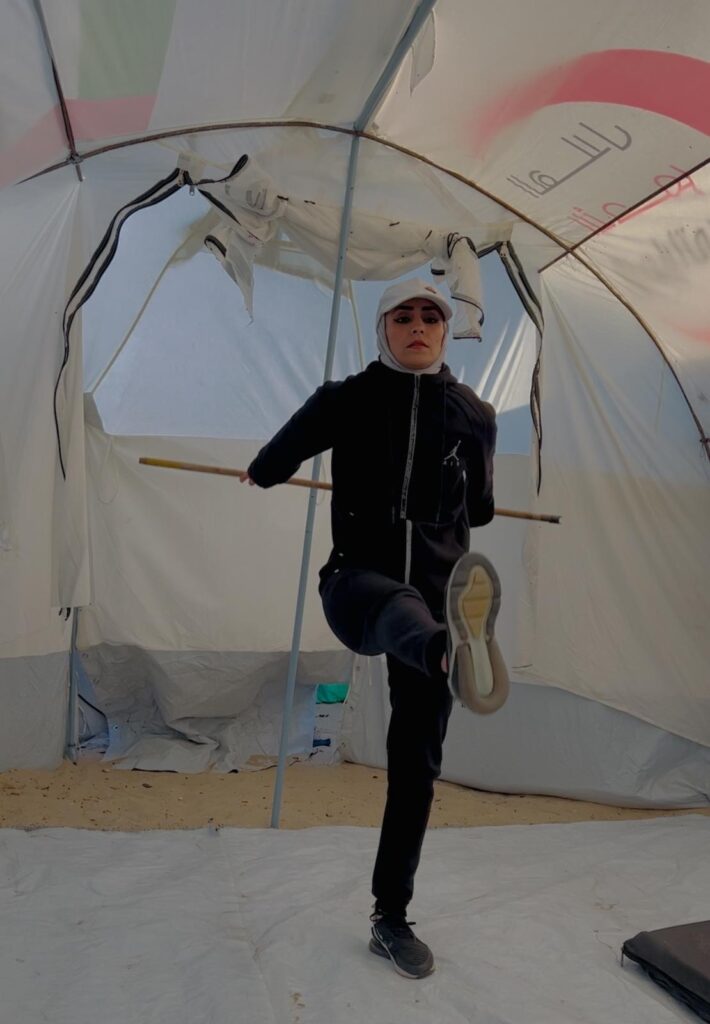
At first glance, the tent's exterior might not attract the attention of any passerby or stranger; It looks like a carbon copy of the hundreds of tents scattered around it, dusty and weather-resistant. But what happens inside, away from the eyes of passersby, tells a completely different story of resistance, one that is both unique and innovative. This simple tent rests on a few light wooden and iron poles, constantly swaying and shaking violently in the wind coming from the nearby beach. If you look closely at the tent's exterior and interior, you'll notice a swarm of odd, simple objects that don't usually belong in a sports center: empty metal food tins from cans of beans, chickpeas, and aid supplies; plastic water bottles and disinfectant bottles filled to the brim with heavy beach sand; torn burlap sacks that once held flour; and a traditional hand broom carefully placed next to the white cloth.
Right at the entrance, bags of rice and lentils are piled haphazardly on the ground, without any apparent order or organization. For the thousands of displaced people in this camp, these empty bags, containers, and other items are simply everyday occurrences—miserable scraps recycled for survival. But for 33-year-old trainer Iman Mohammed Al-Mughair, these things have taken on a different dimension. Thanks to her determination, she has transformed them into alternative equipment and tools that she uses daily to train and rehabilitate women.
Upon entering the tent, the physical challenge is immediately apparent. The space is cramped and can barely accommodate a small number of women at a time. The floor beneath their feet isn't covered with thick exercise mats or shock-absorbing foam flooring like in real gyms, but rather fine sand and dust that swirls around with every movement. During various exercises, this bothersome sand seeps into shoes, clings to clothing, and collects between sweaty fingers. As the daytime heat intensifies and the humidity rises in the afternoon, breathing and moving within this confined space becomes incredibly difficult.
In this makeshift setting, all the amenities of a modern gym are absent, there are no mirrors for women to adjust their movements, no weights, no scales, all that exists is the faint sound of music emanating from a small mobile phone placed in a corner of the tent, which only works when the weak and intermittent internet connection allows. Outside the tent, a few young children of displaced people gather, standing for a few moments, watching the scene with curious wonder, before the wind sweeps them away, re-closing the space. For the women participating in these daily online classes, these exercises are no longer just a way to maintain a slim figure or burn fat; over time, it transformed into a safe haven and a unique space to release intense psychological pressure and alleviate the fatigue and turmoil that had accumulated during months of continuous war and bitter displacement from one area to another. Trainer Iman Al-Mughair explains how this unusual idea began in her mind, noting that the initial spark ignited after the devastating loss of the largest women's gym she owned and managed in the Gaza Strip before the war.
Before October 7th, Iman had been building, step by step, what she considered her professional and personal life project. She is an official member of the Palestinian Federation for Bodybuilding and Fitness and has worked in professional sports training for over eleven years. Not content with her practical experience, she pursued advanced academic studies to earn a doctorate in this specialized field. In 2019, Iman successfully established her first private gym. Thanks to its success and the high demand from women, she gradually expanded this modest project into the largest and most luxurious women-only gym in the Gaza Strip, located in the bustling commercial center of Rafah in the southern part of the Strip, The gym operated at full capacity daily from 7:00 AM to 7:00 PM without interruption.
The gym was a comprehensive facility offering diverse fitness training programs, rehabilitation programs, and well-designed weight loss and gain plans. It also featured a specialized and dedicated section for training women with complex health and hormonal issues such as polycystic ovary syndrome (PCOS), postural problems, and chronic back pain. The large facility also included a nutritional consultation department, a selection of supplements, trampolines, massage rooms, a spacious lounge area for members, and TRX ropes and other suspended equipment.
Iman recalls those days with a tone filled with sadness and deep sorrow for what was lost, and she says literally: "It was my dream project, we expanded it just before the war and we were still paying its installments."
According to financial calculations, the cost of establishing and equipping this massive project with the latest imported equipment exceeded $200,000 USD, money Iman had painstakingly saved over many years. Describing the magnitude of the financial and professional shock, Iman adds, "The gym wasn't just walls and equipment; it was the culmination of my academic and professional life, representing financial security for my entire family and the trainers who worked with me."
Then the bloody war began suddenly, and everything changed in an instant. The commercial building housing the gym was directly targeted by a bombing. It was completely destroyed, razed to the ground. Iman recalls those harrowing moments, noting that she learned of the destruction of her life's work while pregnant with her first child, experiencing the initial hardships of displacement. Describing the psychological trauma, she says, "At that moment, I felt like everything had been extinguished. I kept telling myself that perhaps I would return one day and rebuild, even from under the rubble, but nothing remained." This loss was a devastating blow to her sole source of income and that of her large family. This project provided financial support for her, her mother, her sister, and several other trainers and workers who lost their jobs in the blink of an eye. It was also Iman's primary source of funding for her doctoral studies. After being forced to leave Rafah due to the military operations and constant shelling, Iman embarked on a long journey of displacement. She and her family moved between several displacement camps under heavy fire. They first fled to the Shakoush area in the Rafah district, then moved amidst the shelling to the British Quarter, and then to the Qadisiyah area, before finally settling in the "Fish Fresh" area in the Khan Younis district, living in a modest tent that offered no protection from the heat or the cold.
Iman confirms that the psychological and emotional strain resulting from these successive events and the shock of her gym's destruction exceeded her body's capacity to endure. This caused a sharp and sudden spike in her blood pressure, a particularly dangerous condition for a pregnant woman, forcing her to be hospitalized and receive intensive medical care to save her life and that of her unborn child. Iman continues to describe the bitterness of those days, saying, "The repeated displacement destroys both body and soul. Walking amidst the sounds of shelling while pregnant made me feel I could lose my baby at any moment, but the greatest fear was helplessness." She adds with sorrow that even today, not a night goes by without her opening her phone to look at pictures of her old gym and the beautiful memories, comparing her once stable and successful life to her current existence amidst the sand.
As the long months passed and she found relative stability in the Mawasi Khan Younis camp, Iman began receiving numerous and unexpected messages and calls from her former trainees and other women she had met in the camp. All the messages revolved around one pressing question: how could we exercise and move our tired bodies without gyms, equipment, or weights? Amidst this lack of resources and these questions, the trainer's idea was born, presented simply and gradually.
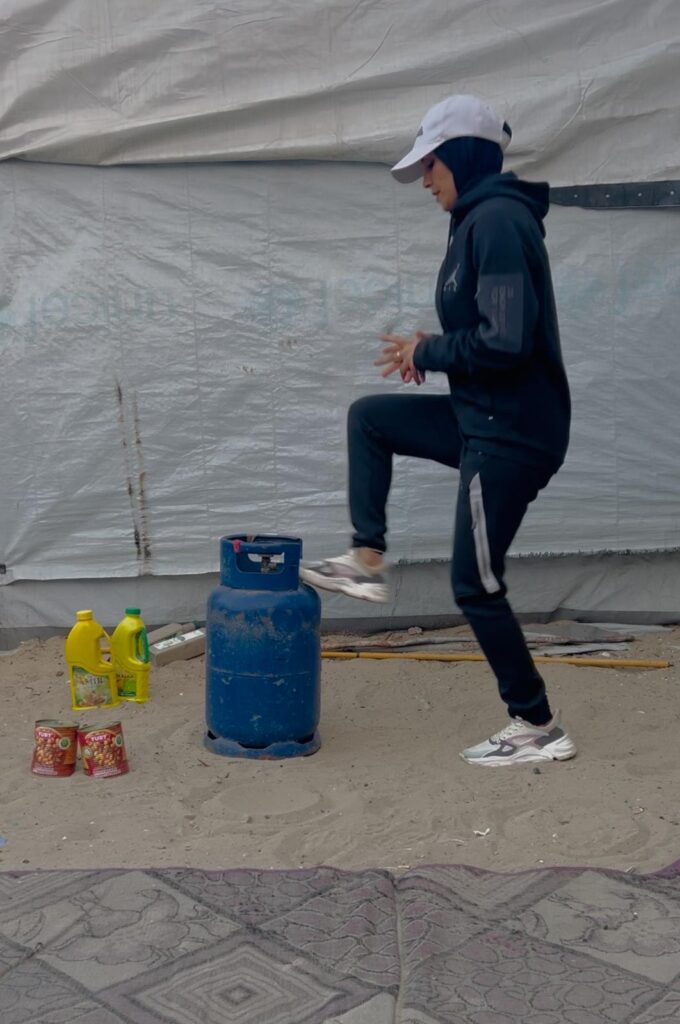
Iman decided not to succumb to reality. She began observing her surroundings inside the tents and devising solutions from available and often overlooked materials. She started using empty cans of cooked beans and chickpeas as substitutes for small hand weights to strengthen arm muscles. She collected large plastic oil and water bottles and filled them with heavy sand to create weights for strength and endurance exercises. She utilized thick, reinforced cardboard aid boxes as alternative platforms for step exercises and tied traditional Palestinian keffiyehs around sturdy wooden tent poles for the women to use as resistance bands. Even plastic chairs, tent poles, and heavy flour and lentil sacks became integral parts of her innovative training sessions.
Iman explains her philosophy behind this invention enthusiastically: "These things are found in almost every tent, meaning any woman can exercise for free." She continues, "When I saw how the women reacted to the first sandbox I lifted, I realized that Gaza isn't dying, and that we are capable of creating alternatives for life amidst the rubble." After the experiment proved successful locally with her neighbors in the camp, Iman filmed short, live videos and posted them on her personal social media accounts from inside her tent.
The public response was swift and astonishing, exceeding all her expectations. Hundreds of women and girls from across the Gaza Strip contacted her, expressing their deep gratitude for these ideas. Some explained that they had suffered from physical pain and muscle stiffness since the beginning of the war due to prolonged sitting and lack of movement, and they found in these simple videos a real outlet to regain their energy and health. Initially, Iman was able to train women in person for a short period inside a large tent provided by a local NGO as part of a psychosocial support project.
However, after the project's funding ended and the tent was closed, the women refused to stop and insisted on continuing to train with her in any way possible. Because opening a safe sports center was impossible while the war continued, and she lacked the financial means to purchase new equipment after losing all her savings, Iman decided to rely entirely on the digital world and social media. Today, more than one hundred women and girls regularly follow her daily lessons and exercises. This participation isn't limited to women inside the besieged Gaza Strip; it also includes her former trainees who managed to leave the Strip and travel to Jordan or some European countries, where they continue to train with her remotely to maintain the human and athletic connection they share with her.
Among the inspiring success stories of this digital club is that of 28-year-old Reem Yousef, displaced from Beit Lahia in the far north of the Gaza Strip. She currently lives in a dilapidated tent in Gaza City, facing extremely harsh living and health conditions. Reem has a prosthetic knee, which makes it very difficult for her to walk short distances, bend her leg, or kneel comfortably and naturally during daily prayers. Due to the blockade, the fragmentation of roads, and the difficulty of traveling between cities in the Gaza Strip, it was impossible for Reem to meet her trainer, Iman, in person. Therefore, Iman began developing a customized training plan for Reem, sending her videos and detailed instructions via WhatsApp. These alternative exercises focused entirely on avoiding strenuous cardio or jumping movements, and instead emphasized strengthening the muscles and ligaments surrounding the prosthetic knee to support and
stabilize it, thus reducing the strain on it.
Reem speaks of this experience with immense gratitude, saying, "After about two months, I started noticing a difference in my movement and walking." She continues, explaining the improvement: "Kneeling during prayer was a distant dream for me because of the stiffness in my knee after the injury. Now, thanks to these simple home exercises, I've regained my flexibility and a new sense of hope has opened up for me." Another story that reflects the importance of this alternative gym is that of Alaa Radi, a 35-year-old displaced woman living in the Nuseirat camp in the central Gaza Strip. Alaa began practicing light exercises under the supervision of Iman Al-Raqami after undergoing a difficult cesarean section in unsanitary conditions. She couldn't leave her two-month-old baby alone inside the tent, nor was she strong enough to walk long distances through the rubble and destroyed streets to reach any remaining health or sports center.
Iman remotely monitored Alaa's condition, sending her gentle and gradual recovery exercises perfectly suited to her post-surgery state, along with nutritional advice to support recovery and breastfeeding. Alaa describes the importance of this initiative, saying, "The videos I share online have become a treasure for displaced women, especially mothers who can't leave their tents or move away from their shelters." Alaa adds, "A cesarean section in the camp is real torture, and movement is very difficult, but these videos gave me a chance to recover and regain my strength without the hardship of moving around and risking my baby in these conditions." The benefits weren't limited to physical rehabilitation; they extended to women facing weight gain and obesity due to their complete reliance on canned foods high in sodium and carbohydrates distributed as aid. Sawsan Azzam, a 25-year-old displaced woman in the southern Gaza Strip, is a striking example of this challenge. Her weight had reached nearly 100 kilograms when she was displaced, causing her joint pain and shortness of breath.
Sawsan decided to commit to Iman's fitness program, available via phone, and combined it with a strict calorie-restricted diet. Within a few months of continuous effort, Sawsan achieved a personal miracle; her weight dropped to around 70 kilograms. Sawsan and her friend now collect every empty tin can that comes with aid packages, turning them into weights to exercise together inside their small tent. Sawsan describes this new reality: "These tools have become part of our daily lives; we exercise with whatever we can find." Sawsan continues proudly, "Losing 30 kilograms amidst the siege and displacement is my personal battle, which I won. The empty tins of beans now bear witness to this daily challenge." The training sessions offered by Iman from her tent include a wide range of innovative programs: full-body toning exercises, strength training using sand weights, yoga, and breathing and relaxation exercises to alleviate psychological trauma. She also offers weight loss programs and therapeutic exercises specifically designed for women suffering from polycystic ovary syndrome (PCOS) and fat accumulation in certain areas of the body due to constant stress.
The transformative trainer emphasizes that working from inside a displacement tent is anything but easy; it's more like a nightmare and a constant daily challenge. The frequent power outages prevent her from charging her mobile phone and flashlights. The weak and extremely slow internet connection means that uploading a five-minute video takes an entire day or often fails altogether. She finds it incredibly difficult to find someone willing to hold the phone and film her while she performs the challenging exercises, and she often has to prop the phone up on a cardboard box or a sandbag. And the obstacles weren't limited to technical and logistical aspects; Iman also faced a wave of harsh criticism and negative comments from some conservative groups and mindsets on social media platforms. They considered it inappropriate or unnecessary for a woman to practice sports and film herself amidst war and displacement. However, Iman faced these criticisms with unwavering confidence and shrugged, continuing on her path.
She explained, "This brought me back to the field I love and gave me a reason to persevere despite everything." Iman added, clarifying her stance on the attacks, "The criticism doesn't stop me because I know very well the benefit and comfort women find in this tent. Sports are not a luxury; they are a vital need for their mental and physical health amidst this devastation." Despite the immense strength she displays to boost the morale of the women and trainees, Iman hides behind her smile a deep personal and human pain that tears at her heart as a mother. Her first and only child was born amidst this brutal war, specifically inside a temporary medical tent belonging to the Red Crescent in the Mawasi area of Khan Younis. This child has known nothing in her short life but canvas walls, the sound of fierce winds, and the vast expanse of sand. Iman says, her eyes glistening with tears, "My heart breaks because my first child was born and is growing up among sand and tents… I always imagined she would grow up and play beside me in the luxurious gym I used to own."
Currently, the hot, shifting sand outside the tent remains the only training surface available to Iman and her colleagues. This work and training on the soft sand is very strenuous, exhausting for the muscles, and scorching in the heat. However, Iman is determined to radiate positive energy and spread joy among the women, laughing as she speaks, "Training on the sand is harder and burns more calories!" Every day, Iman receives urgent and repeated requests from dozens of women in the camp, begging her to find a way to open a proper gym on the ground, even a small one made of wood or corrugated iron, to provide them with more privacy and safety while exercising. Deep down, she knows that this seems almost impossible, at least for now. After losing her life's work, her equipment, and years of savings, she finds herself without any capital or funding to even buy a single piece of wood. Therefore, in the absence of any magic solutions or external support, Iman refuses to give up or let despair creep into the minds of the women around her. She concludes her interview with Intifada website with a statement that encapsulates her reality: “No matter how many of our dreams they destroy, we will continue to invent alternatives from the simplest tools of life. A true gym isn't about iron equipment; it's about the unwavering will that is deeply
rooted within us.”
Every afternoon, the young trainer returns with her tired body and unwavering determination to the same spot of sand, opens her mobile phone, and makes from the junk, empty boxes, and neglected things that the world threw away and that the war brought down… a new gym that pulsates with life and hope in the face of destruction.