
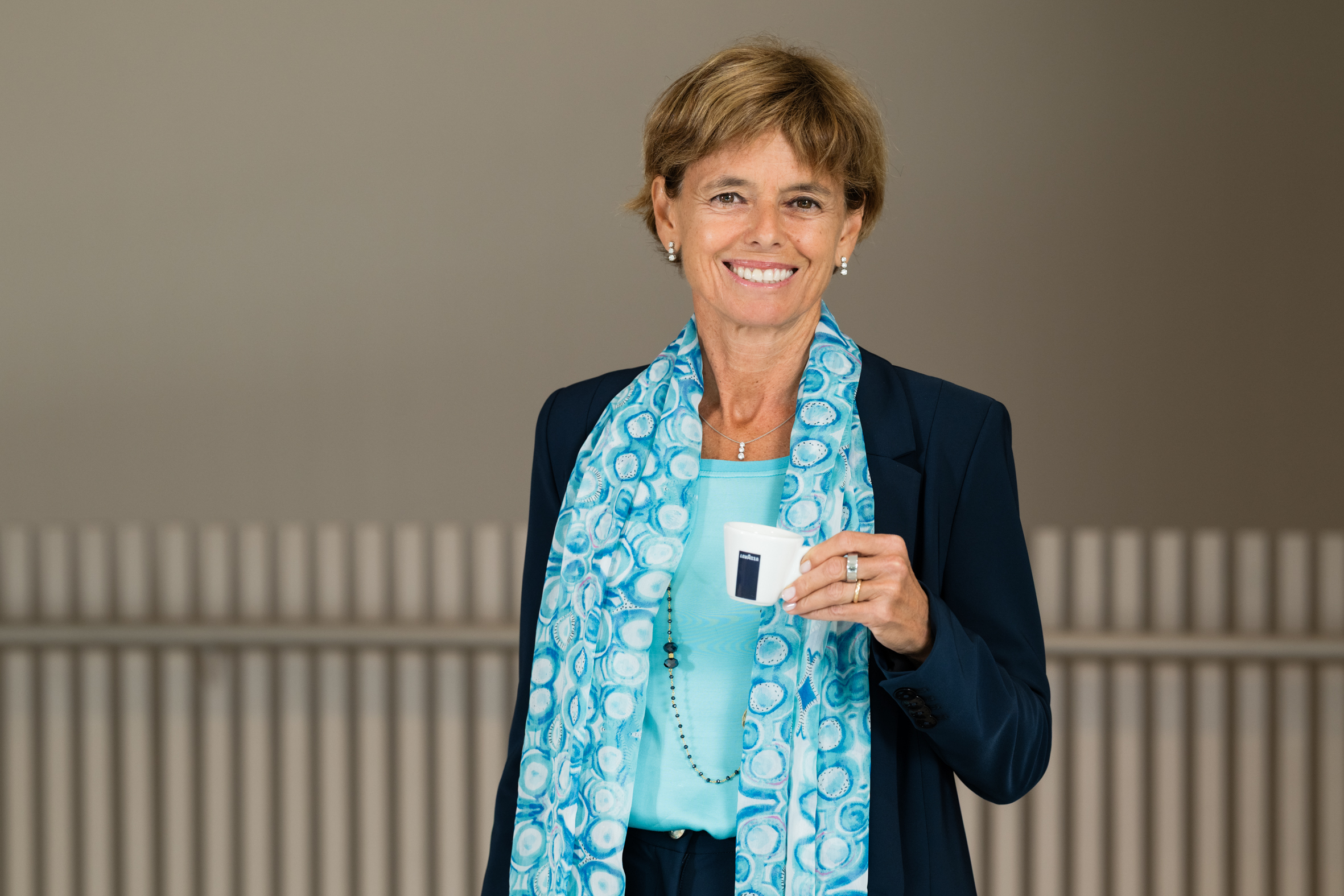
In a company, AI cannot be accessible to just a few people
What does your new Digital Transformation function, established in 2025, focus on?
Our mandate is to transform the Lavazza Group into a digital ecosystem where a data-driven culture and the digitalization of processes—through the adoption of AI—enable more effective decisions, greater competitiveness, enriched experiences for clients and consumers, and sustainable growth. This transformation will be guided by an approach focused on high-impact areas for the business, aligned with the strategic priorities of the Lavazza Group. The structure is based on three areas:
- Baseline & Foundation: management of existing technology platforms, continuous improvement, and definition of the IT architecture.
- Evolution: projects aimed at optimizing business processes through market-ready solutions with minimal customization to ensure scalability.
- Transformation: high-impact strategic initiatives developed by multidisciplinary business-tech teams (squads) to drive digitalization and cross-functional collaboration.
How do you use AI in the Lavazza Group’s digital transformation process, and in which areas? For example, in products, services, recruiting, etc.
Today, AI is already present in several areas of the company—whether to simplify our professional productivity (tools that summarize emails, transcribe meetings, or assist in drafting documents) or to experiment with new forms of creative communication. We use both Generative AI and traditional AI tools to support data-driven decision-making.
Have you personally encountered potential biases in AI that could affect the fairness of its outputs?
I believe the “Human in the Loop” method is very effective. Biases can often stem from ineffective prompts or from underlying data that is insufficient, leading to the well-known GIGO (Garbage In, Garbage Out). That’s why, in companies, data governance and data strategy are of primary importance—even before developing AI or GenAI solutions. Models learn from the data they have available. Personally, I haven’t encountered biases, but sometimes the AI gave responses that were not fully satisfactory when I was researching online; in those cases, I notified the tool, which politely apologized and corrected its answer, enriching it based on my additional request. This made me reflect: was the issue with the tool, or was my prompt not explicit enough? I think that, as with all new and innovative solutions, a phase of mutual learning is necessary.
Digital and IT functions have historically been male-dominated. Have you observed changes in recent years? Do you see more women entering these roles, and if so, what are the main challenges (cultural, organizational, or career-related) they face today?
Thinking back to my engineering degree, women could be counted on one hand, whereas today in some programs they are almost half. This reassures me: we are on the right track, although the gap is still significant. To reduce it, we must start from schools and families, providing equal encouragement to both girls and boys. My daughter is a proud engineering student, while my son chose economics—perhaps having an engineer mom helped show that there are no barriers. If more girls study digital and IT, it will be easier for companies to hire new talent, who will later form the foundation of tomorrow’s management. However, this process must be strongly driven by companies, because humans tend to choose people similar to themselves. Strong awareness is therefore crucial: diversity should be seen as an enrichment for the company. Lavazza has invested heavily in this, and the results are already tangible.
What are your next goals as Chief Digital Transformation Officer?
The first goal was to hire new profiles with AI and data management expertise, as well as business skills to interact effectively with other company departments. Transformation is first and foremost about people. Innovative solutions must be co-designed with the business to meet their needs and be easy to use. AI, like digital tools in general, works best when it is transparent—that is, it simplifies work and becomes so intuitive that we barely notice it. It should not remain a tool handled by a small group of technicians, but should become a way of working for everyone in the company. I will consider my work successful when my role is no longer needed.