
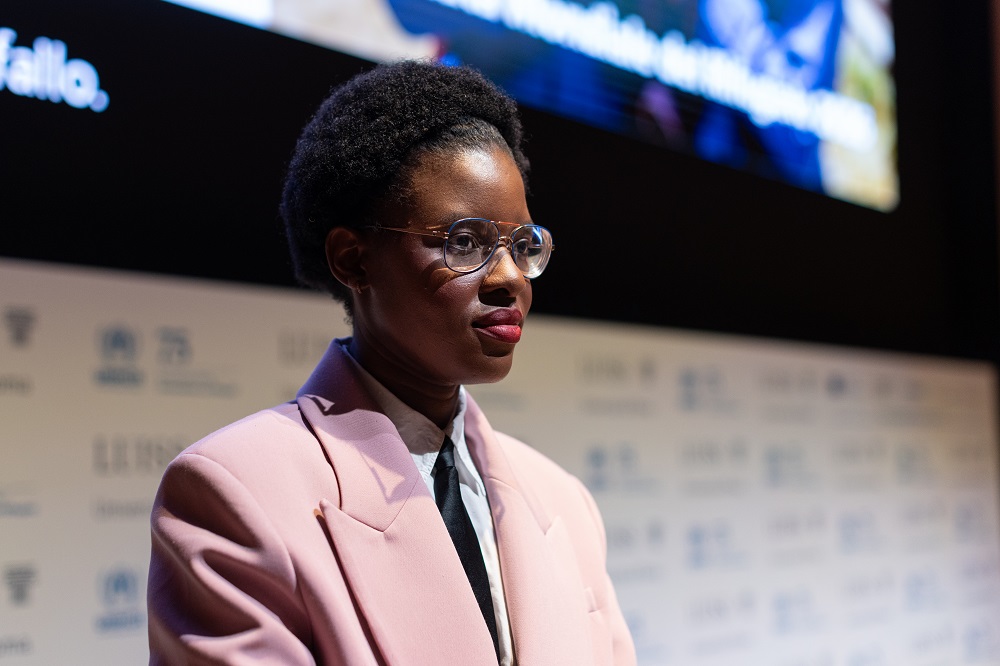
Beyond visibility: the freedom to discover who we are
The initiative aims to enable nearly 8 million people to access opportunities for learning, employment and social inclusion, moving beyond a logic based exclusively on assistance and recognizing the contribution they can make to the communities that host them. Among the most effective tools for achieving this goal are regular and complementary pathways of entry, which allow refugees to safely and legally access opportunities for study, work or family reunification in third countries. In this context, the UNICORE project – University Corridors for Refugees, coordinated by UNHCR together with Italian universities and numerous institutional and civil society partners, represents one of the most innovative initiatives at the European level. Active since 2019, the programme enables refugee students to reach Italy through a study visa and enrol in university courses thanks to dedicated scholarships and support services. Rehema Amisi was selected as part of the UNICORE project by the University of Cagliari, where she currently studies International Management.
Pride invites us to celebrate who we are. But what happens when you have never been given the freedom to discover who you truly are? I understand what Pride represents. I understand its history, its struggles and the courage of those who refused to remain invisible. I understand why visibility matters, why representation matters and why, for generations, people have fought to live without hiding parts of themselves. But when I turned this question towards myself, I struggled to find an answer.
What does Pride mean to me? Before I could answer, I had to face another question. Who am I? I don’t know. I truly don’t know who I am. It might seem surprising coming from someone who speaks in public, advocates for others, and has spent years building communities. From the outside, my identity might seem clear. I am a woman. A refugee. A student. An activist. A professional. A daughter. But these are the roles I have carried on my shoulders. They are chapters of my story. They are not the complete answer to the question of who I am.
For many people, identity is something they are encouraged to explore. From childhood, they are asked what they like, what their dreams are and what they want to become. But for millions of other people, identity is shaped before they even have the opportunity to question it. I grew up in a world where survival mattered more than self-discovery. Where obedience was valued more than curiosity. Where being a “good” woman meant learning other people’s expectations before getting to know herself. «Uzuri wa mwanamke ni ukimya» (in Italian, «Il valore di una donna è il suo silenzio»). This is a phrase that was repeated to us as girls.
A woman must be respectful. A woman must endure. A woman must protect the honour of the family. A woman must know when to speak and when to remain silent. The lesson is not always conveyed through words. Sometimes it is taught through traditions, through expectations, through what is celebrated. And sometimes it is imposed through fear. Through violence used to teach obedience. Through humiliation used to break resistance. Through deprivation and threats. Through the warning that stepping outside the assigned role will not only affect you, but also your family and your place in the community. For many women around the world, silence is not simply a personality trait. It is something they learn because speaking has consequences. When you grow up in environments like these, you become skilled at adapting. You learn to survive. You learn to meet expectations. You learn to become what others need you to be. But survival comes at a cost.
When all your energy is focused on surviving, there is little room left to ask yourself: What do I want? What do I believe in? Who would I become if I were free to choose? Now imagine being a refugee woman, on top of all this. Imagine spending years trying to understand who you are while carrying a label that enters every room before you do, constantly overshadowing everything else. For me, these identities cannot be separated.
One tells you who a woman should be. The other tells you what a refugee is expected to be. And behind every label is a woman trying to discover herself, but who has never been given the space to do so. And even when she believes she has finally been given that space, when she begins the journey of self-discovery and finds her voice, she realizes that this freedom comes with conditions. She can speak, but her story must fit a certain narrative. She can be visible, but only through the parts of herself that other people recognize. She can be celebrated, but often only for her ability to survive, not for her ability to imagine, create and lead. The world may open a door, but sometimes it still tries to decide how she should walk through it.
For women like me, the struggle is not only finding a voice. It is protecting that voice from being shaped by other people’s expectations. Because true freedom does not simply mean having permission to speak. It means having the freedom to decide what you want to say. And this is where many organizations and institutions continue to face difficulties. Opening a door does not necessarily create freedom. If a person enters a space but still feels that they must carefully choose their words, protect themselves from consequences or modify their story to fit what is expected of them, then power has not truly changed.
Empowerment should not come from fear. No one should have to wonder whether speaking honestly will cost them opportunities or acceptance. No one should have to trade authenticity for belonging. Because when conditions replace trust, empowerment becomes another form of control. The purpose of creating spaces for marginalized communities should not be to give people a voice that can still be controlled. It should be to create environments where people have full ownership of their own voice. Because a voice is not truly free when someone else still decides how far it can go.
This is where we must ask ourselves what inclusion really means. Are we creating spaces where people are celebrated for who they are, or only for the version of themselves that makes others feel more comfortable? True pride is not found in being exposed. It is found in the freedom to define oneself, even when that definition challenges what others expect. Because what many of us want is what many Western women take for granted: the freedom to exist, to dream, to dare, to think, to speak and to love who we choose without this being considered an aberration, without the fear that violence will be used as a way to “correct” who we are. To be a woman without seeing your worth reduced to marriage, motherhood or the ability to have children. No person should live with this fear simply because they exist.
We want the freedom to discover ourselves without being punished, to make mistakes without being condemned and to become who we are without asking for permission. This freedom also requires institutions and organizations to stop confining people within labels. The purpose of protection should not be to replace one label with another. It should be to create the conditions for people to be free to define themselves beyond every label that has been imposed upon them. At 30, I am still learning who I am, because for much of my life the world has tried to tell me who I should be. A refugee. A woman. An African. A survivor. A beneficiary.
Every label carries expectations, assumptions and limitations. After years of living within identities assigned by others, discovering who I am beyond those labels has become the most difficult journey of all. I am Rehema. Not Rehema the refugee. Not Rehema the survivor. Just Rehema. Let me meet her, understand her and discover who she is beyond everything the world has already decided she should be.