
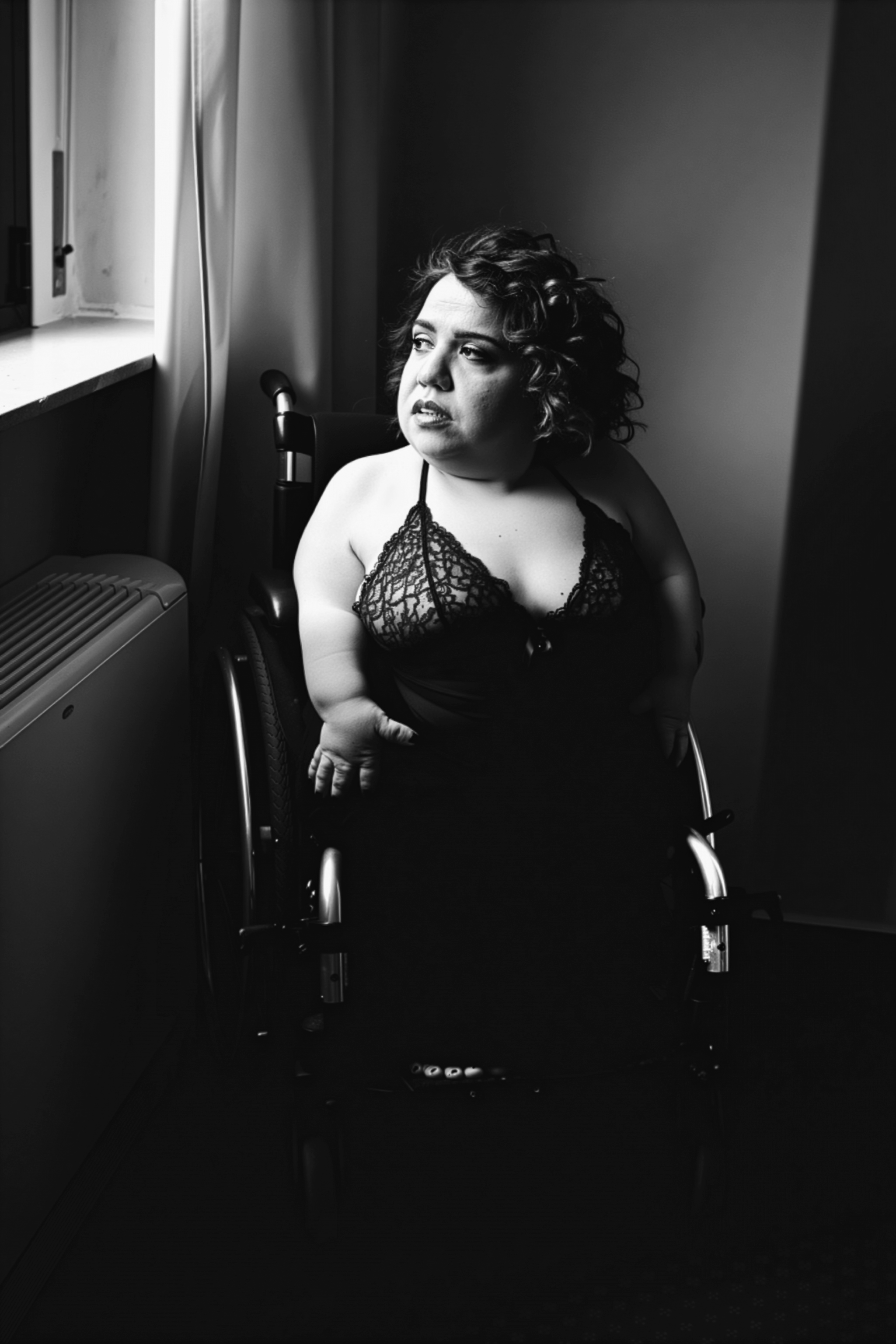
Marginal bodies. Aesthetics, care and disability
The body is always political. But it is even more so when it doesn’t conform to the expected, tolerated, and marketed standards. The disabled body—real, changing, visible—is the great absentee in conversations around aesthetic care. Not because it doesn’t exist. But because it has historically been confined within a double boundary: that of illness and that of renunciation. The dominant narrative has taught us that a “non-conforming” body doesn’t need to feel attractive—only to survive. As if simply existing were already too much to ask, let alone desiring beauty. And yet, taking care of one’s body—even through aesthetics, fashion, accessories, colors, image choices—is a form of self-determination that has everything to do with mental health, dignity, and the right to take up space. I speak from experience.
I am an adult woman, in a wheelchair, with a visible disability since birth. I have always loved bold lipstick, sharply cut dresses, shoes with useless but beautiful details. But every time I choose to “take care of myself,” that measuring gaze arrives: “Why do you need to do that?” As if aesthetics were a reward reserved only for those who fit certain measurements. As if my body didn’t deserve attention, beauty, lightness. There’s a collective and internalized sense of guilt that comes with every act of aesthetic care for someone with a body marked by disability. Guilt for “not being as one should.” Guilt for still wanting to attract, communicate, be seen. Guilt for investing in a body that society has already written off as “defective.” But taking care of oneself is also an act of resistance: it means breaking the mold that wants us as grey, neutral, invisible bodies.
When we talk about inclusion in healthcare pathways, we often stop at diagnosis, treatments, access to care. But health is not just the absence of illness: it is also wellbeing, representation, recognition. A healthcare system that excludes bodies like mine from prevention campaigns, from advertising images, from medical devices designed to a single standard, is actively choosing to ignore part of humanity. Likewise, an aesthetic that doesn’t include body diversity in its narratives isn’t neutral—it’s exclusionary.
There is also a structural issue. Aesthetic services are almost never accessible. Not physically—with architectural barriers that make entry or the use of treatment tables impossible—nor economically, for those living on inadequate disability pensions. Beauty remains a privilege, not a right. Yet it should be. There should be an accessible aesthetic, designed for all bodies, with tools, environments, and language that are appropriate. Without pity, without infantilization, without sensationalism. In this culture of efficiency and performance, the disabled body is still seen as a failure.
But what would happen if we changed perspective? If we began to see it as a full, whole body, capable of expressing identity, desire, style? If we redefined the very idea of normality, stopping measuring health against conformity to a standard? In the end, it’s not just about “including” non-conforming bodies, but about rewriting the rules of the game. About stopping the idea that aesthetics is a reward for those who conform, and starting to recognize it as part of care. A kind of care that doesn’t cure, but sustains. That doesn’t hide, but claims. That doesn’t conform, but liberates.
I don’t want to have to choose between visibility and respect, between self-determination and acceptability. I want an aesthetic that also speaks my language, that knows my story, that can imagine me—and anyone else—as part of the possible horizon. An aesthetic capable of embracing all bodily trajectories, without hierarchy. Because every body is valid. And every body deserves care—even the most frivolous, seemingly superficial kind.