
Who do the stories belong to?
Many contents today are still far from inclusive, concretely affecting people’s lives and their ability—or inability—to access entertainment, information, services, and opportunities. This is therefore a choice that concerns any audiovisual product and invites us to ask: who is included and who is not?
Who can truly see and hear these stories? Who can access fiction, documentaries, online courses, or webinars? Who can experience the intense emotions of La Notte by Michelangelo Antonioli and other extraordinary works of our artistic and cultural heritage? Whether it is films, TV series, branded content formats, advertising, social media, or any corporate communication, accessibility stops being a niche issue and becomes a criterion of cultural as well as industrial quality, because it concerns the way products are conceived, produced, and shared. It means integrating accessibility as a language and structural component of every creative and productive project from the ideation stage.
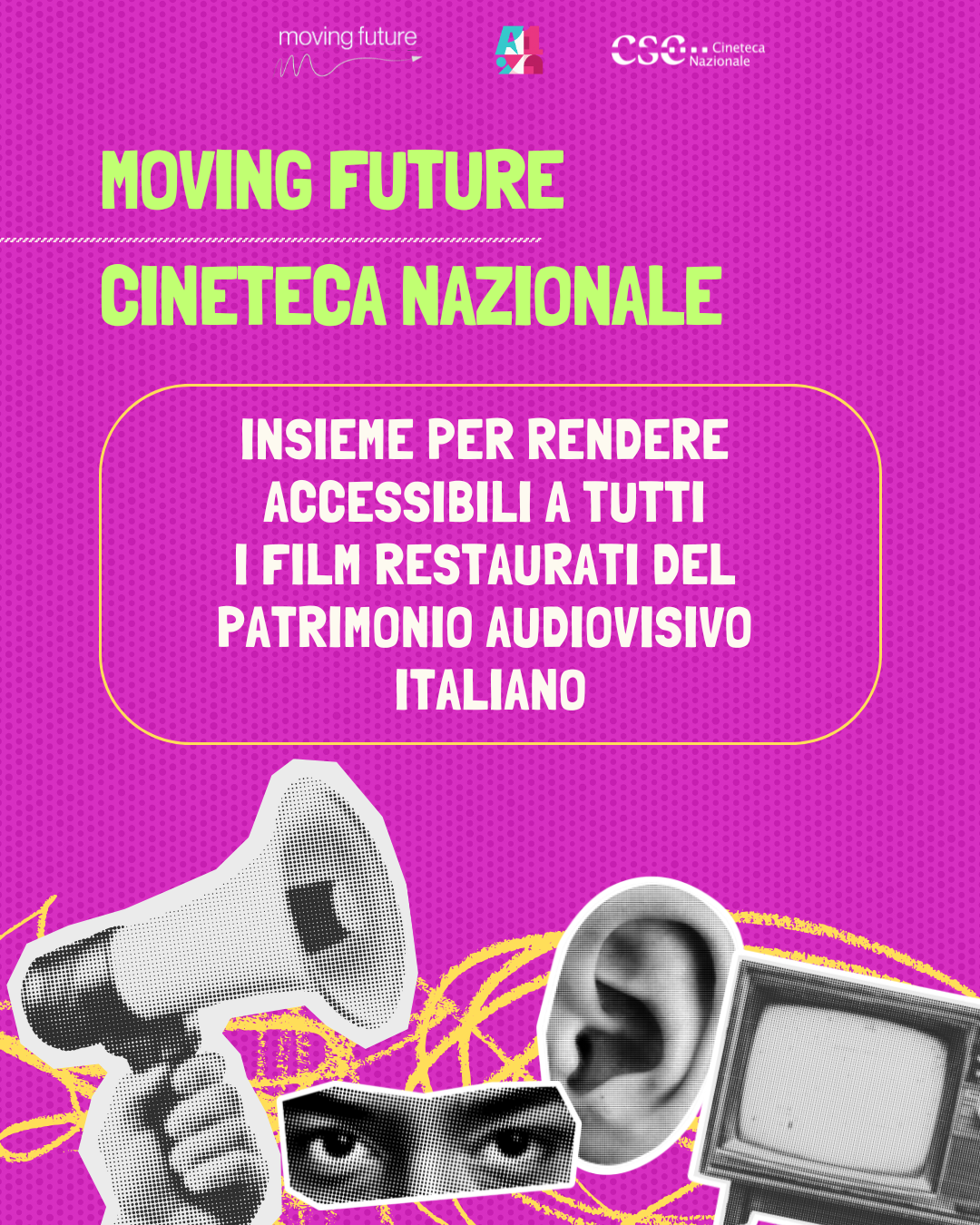
It is not the person who is “dis-able,” but the context—or more specifically, the content lacking the necessary accessibility components. This is the principle behind Moving Future, the inclusive laboratory of Marvin Film— a production company led by Giacobbe Gamberini— and a strategic partner for audiovisual content accessibility, with the aim of ensuring high-quality experiences open to the widest possible audience, including people with sensory disabilities.
Moving Future supports and meets the needs of various organizations in making their content accessible according to the highest standards. It is a cross-media service, spanning cinema and entertainment as well as corporate and institutional contexts, assisting organizations that produce large volumes of content and are called to integrate ESG, reputational, and cultural criteria into their communication strategies. From this perspective, accessibility becomes a lever of value and positioning, as well as an integral part of how we choose to tell the world today—and tomorrow. The goal is not merely to adapt individual content pieces, but to contribute to a paradigm shift, rethinking workflows and models, involving distributed expertise, and co-constructing paths of cultural validation in co-design with specialized partners such as Eye-Able and BlindSight Project ODV.
With this same perspective, AI is viewed as an ally to expand access to culture, information, and their production. The most advanced approach involves the use of AI models in learning mode, subjected to regular and continuous testing, with the goal of training a large language model specifically for the audiovisual accessibility segment. This is a complex and layered field, providing sophisticated support for cultural mediation, which is beginning to play a significant role—not as an automatic shortcut, but as an invisible infrastructure capable of accelerating processes and creating new possibilities for inclusion.
Advanced audio description and subtitling become faster and more sustainable at large scale, generating texts that increasingly capture nuances, connect meanings, and perform contextual analysis. Yet, however sophisticated, the technological component does not exhaust the human dimension and its capacity to recognize plurality and complexity as a value, situating technological processes within a broader framework that embraces narrative intent, pacing, and responsibility. Giacobbe Gamberini, CEO of Marvin Film, comments: “Accessibility is a strategic and cultural choice, first and foremost, before it is technical: a conscious act that redefines the way we produce and distribute content. Investing in accessibility means fueling innovation, imagining universal languages. Culture belongs to everyone, and inclusion is a revolutionary act.”