
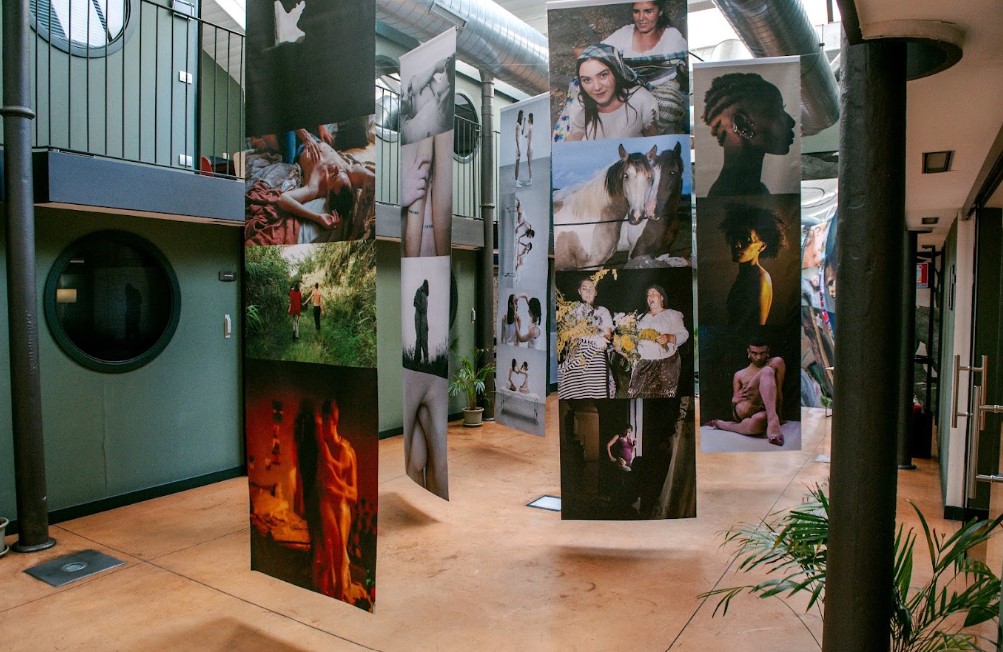
An exhibition to be seen
The central themes of the exhibition were love, identity and the freedom to express oneself through the idea of the reflection, understood as a device to investigate oneself and trace one’s essence in the gaze of others. In what way does this conception of reflection lead a person to feel proud in revealing, expressing and representing themselves beyond society’s labels and standards?
Specifically, the idea of the reflection understood in this way came to Erica Bellucci from Visioni Parallele (who was responsible for the creative direction of the exhibition) but all of us were interested in going beyond the classic reflection-mirror pairing in order to overcome the concept that there is only what we see of ourselves. In a society in which we are constantly exposed to the gaze of other people and to their judgments, we wanted to create a space in which it was easy to understand how, through the reflection, we are seen by other people and what we discover about ourselves precisely thanks to this external gaze. Also because our identity is often built in the relationships we have, in the people we meet and who make us feel welcomed or, on the contrary, invisible. Seen represented a safe space in which one felt observed but not judged.
How was the process of choosing the artists who took part in Seen structured?
Right at the beginning, while we were planning the exhibition, we asked ourselves: «Why don’t we bring into Seen the point of view of the people who actually do this for a living, the photographers precisely, and who can offer a different and original perspective on identity, love and pride?». And so the whole process was born which, to tell the truth, was completely fluid and natural even though the works could seem completely different, but this was precisely our objective: to create several banners capable of telling the same theme but from different points of view, creating harmony in diversity. With their works, each photographer answered the question «What does it mean for you to be seen?». For Clara Borrelli «to be seen is to be playful» while for Marco Servina and Matteo Strocchia it is to be recognized; for Alex Cepeda «to be seen is to be loved», so they brought photographs that represented both the idea of love between two people and towards oneself. Again, for Chiara Lombardi «is to be felt» and therefore her works depicted bare skin in a very delicate way, while for Mirko Ostuni being seen means freedom. Then there was Alessandro Ruggieri who, thanks to his photographs of writings on walls or on old mobile phones, explained that for him being seen means being read; finally, for Petra Valenti «to be seen is to be nurtured», nourished and welcomed, so she provided us with very interesting photographs of human and animal mothers and daughters.
The gaze of the other person, the possibility of being welcomed and observed without judgment were central themes in Seen. In what way do you believe that identity representation promotes greater inclusion and psycho-physical well-being for people and/or communities that, instead, are often left on the margins of society?
The exhibition arrived during Pride Month and it was wonderful that way, but in reality the concept was not linked only to the LGBTQIA+ community but also to other minorities or, for example, to people with fragile mental health, with self-esteem and self-recognition issues. By giving space to people’s different life experiences (culture, sexual orientations, personal choices), we give value to their differences and uniqueness beyond judgments and stereotypes. Representation, therefore, is fundamental because when people see themselves represented they feel less alone and recognized. I also believe that through this desire to know the other and through dialogue, precious connections can be created.
The journey concluded with a participatory installation and collective artwork that posed a question: «What does it mean to be seen?». Could you tell us how this idea of ending the exhibition with the desire to give the other person a voice came about?
For us it was important that the thoughts of those who visited the exhibition be preserved in a sort of archive, a mirror, which showed intimate feelings and emotions. The objective was to ensure that a person, after seeing all the works and immersing themselves in the various points of view, arrived at the mirror and formulated their idea of what it really means to be seen. Thus the reflection represented a moment of meditation to find one’s own answer and leave one of inspiration for others. Returning to the concept of representation, perhaps on this mirror a person could find their own answer already written by someone else and feel understood and less alone.