
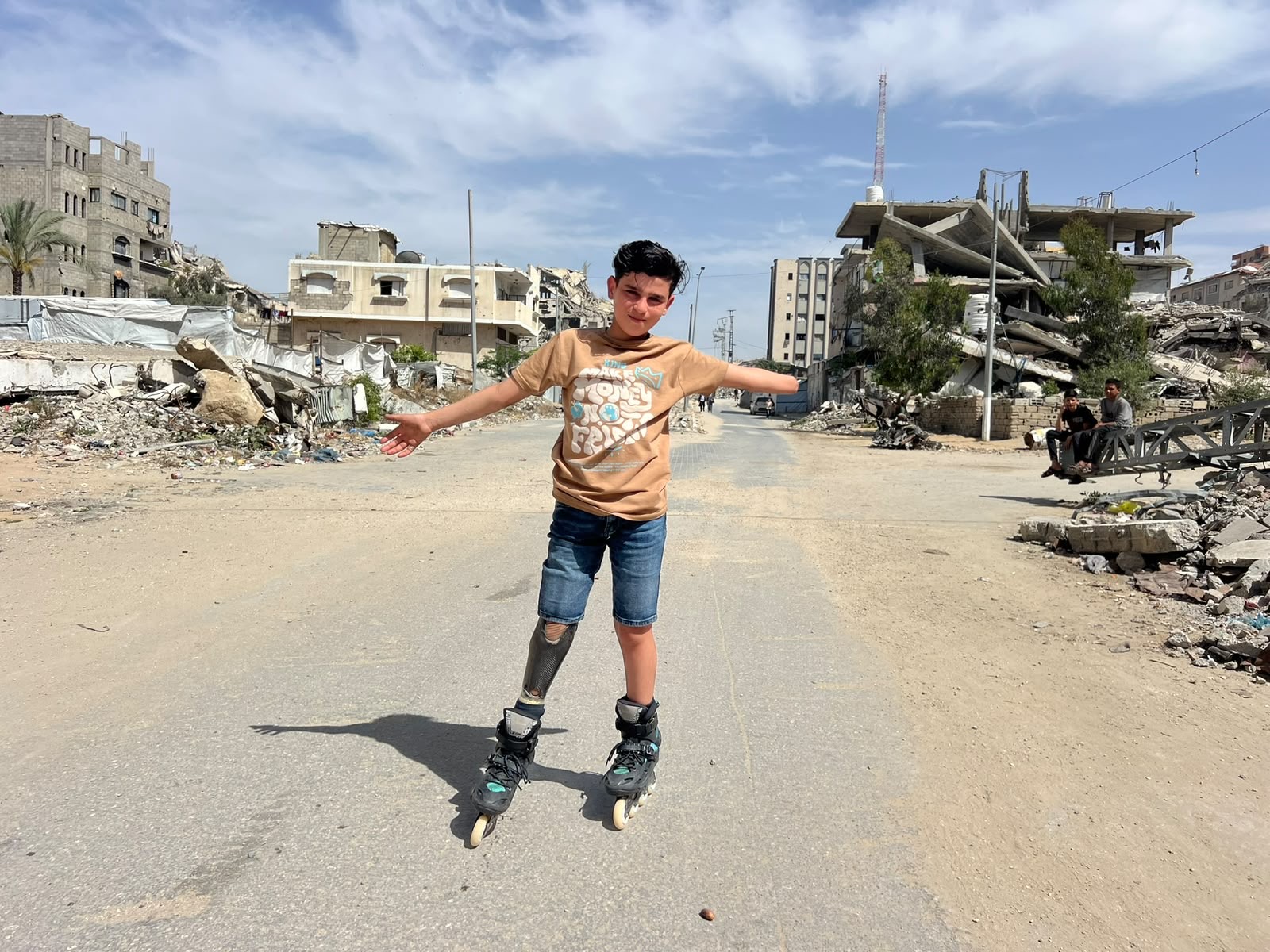
Akram: skating beyond the loss of his limbs
“I was washing my roller skates because I wanted to play with them while they were clean, Suddenly, everything around me was covered in blood, and my hand was gone.”
Akram Sherif Al-Fayoumi was 12 years old when an Israeli strike hit the area around Abdel Fattah Hammouda School in eastern Gaza City in August 2024, He had been washing his roller skates with several friends near the school, where his family had sought refuge after repeated displacement.
Within seconds, the place where Akram had been preparing to play became a scene of blood and panic, His left hand was severed, while his right leg suffered devastating injuries, Several of his friends and other displaced people nearby were killed, according to his father, Akram survived. “I saw blood everywhere, but at first I could not understand what had happened,” Akram recalls, “Then I realized that my hand had been severed.”
Doctors later amputated his right leg in the hospital. At 12, Akram left the hospital with a body that had changed permanently and a childhood that would now depend on rehabilitation, prosthetic devices and the limited resources available to his displaced family.
Akram’s injury forms part of a wider toll on children in Gaza, UNICEF reported that 44,500 children had been injured in the Gaza Strip between 7 October 2023 and 3 February 2026. The agency has also warned of the long-term rehabilitation needs facing children who have suffered severe injuries.
Before the war, Akram loved riding horses. But repeated displacement made his old hobby impossible, When his family sought shelter at the school in eastern Gaza City, he found another way to keep moving. He asked his father to buy him roller skates. When Sherif finally managed to get them, Akram began skating from morning until evening with other children sheltering at the school, They raced each other, challenged one another and turned the space around the shelter into a temporary playground.
For Akram, the skates offered something the war had taken away: the freedom to move. Then, while washing them with his friends, the strike hit. The boy who had been preparing his skates for another race was suddenly unable to walk, run or play as he had before. For his father, Sherif, the injury was also a painful reminder of why the family had sought refuge at the school in the first place.
“My son’s only crime was that he was playing at the entrance of the school where we had sought refuge,” Sherif says. “We were displaced from death only to find death waiting for us again.” After the amputation, Sherif struggled to watch his eldest son lose his independence, With limited means, he helped him obtain a basic prosthetic limb and began teaching him how to move with it.
Walking became a new skill. Akram had to learn how to balance his body, adjust his movements and live with a prosthesis that could help him move but could not return his body to the way it had been before the injury. His father, however, did not want the injury to take away the sport Akram loved. He encouraged him to return to skating. Together, they began adapting the activity to Akram’s new body, Gradually, he learned to balance himself on the roller skates and move again.
“Despite my injury, I still have hope that I will become better,” Akram says. “The amputation did not stop me from practicing the sport I love. But I want to be like my friends, I want to walk without having to wear a prosthetic limb every day.” His wish goes beyond sport.
Akram wants to move independently. He wants to walk without constantly relying on a prosthesis, He wants to spend time with his friends without his disability determining what he can and cannot do.
Today, Akram is 13 and lives with his family in a tent in western Gaza City, far from the school in the east where he was injured. Displacement has continued to shape his life, but he has also taken on responsibilities at home, As the eldest son, he helps his family collect and transport water, doing what he can despite the limitations caused by his injuries.
For Sherif, watching his son continue to help the family brings pride, but it also carries pain. “Every time I look into Akram’s eyes, I wish I had been the one injured instead of him,” he says, “I wish I had lost my hand and leg rather than watching my child live with this pain.”
Sherif hopes his son can travel abroad to continue his treatment and receive advanced prosthetic limbs that could improve his mobility and give him greater independence, The family currently relies on a basic prosthesis and their own efforts to support his rehabilitation.
Until that becomes possible, Akram keeps training. He places himself carefully on the roller skates, adjusts his balance and pushes forward, Every movement demands concentration, but he continues. The races are no longer the same. His body has changed, and skating requires an effort that it never did before, Yet the activity that began as a way to pass time during displacement has become part of his attempt to reclaim his childhood.
The roller skates that once waited to be washed before a game now carry a different meaning. Akram still wears them. He still skates. And each time he pushes himself forward, he moves a little farther from the moment when the blood covered the ground and his hand was gone.
Rights at Stake
Akram’s story engages children’s rights to life, survival, development, health and protection during armed conflict, as recognized under the Convention on the Rights of the Child. As a child with a disability, he has the right to rehabilitation, assistive devices and support that can help him regain independence and participate in society. The Convention on the Rights of Persons with Disabilities also requires protection for people with disabilities during armed conflict and humanitarian emergencies and recognizes their rights to mobility and rehabilitation. Children with disabilities are also entitled to participate in recreation, leisure and sport on an equal basis with other children.