
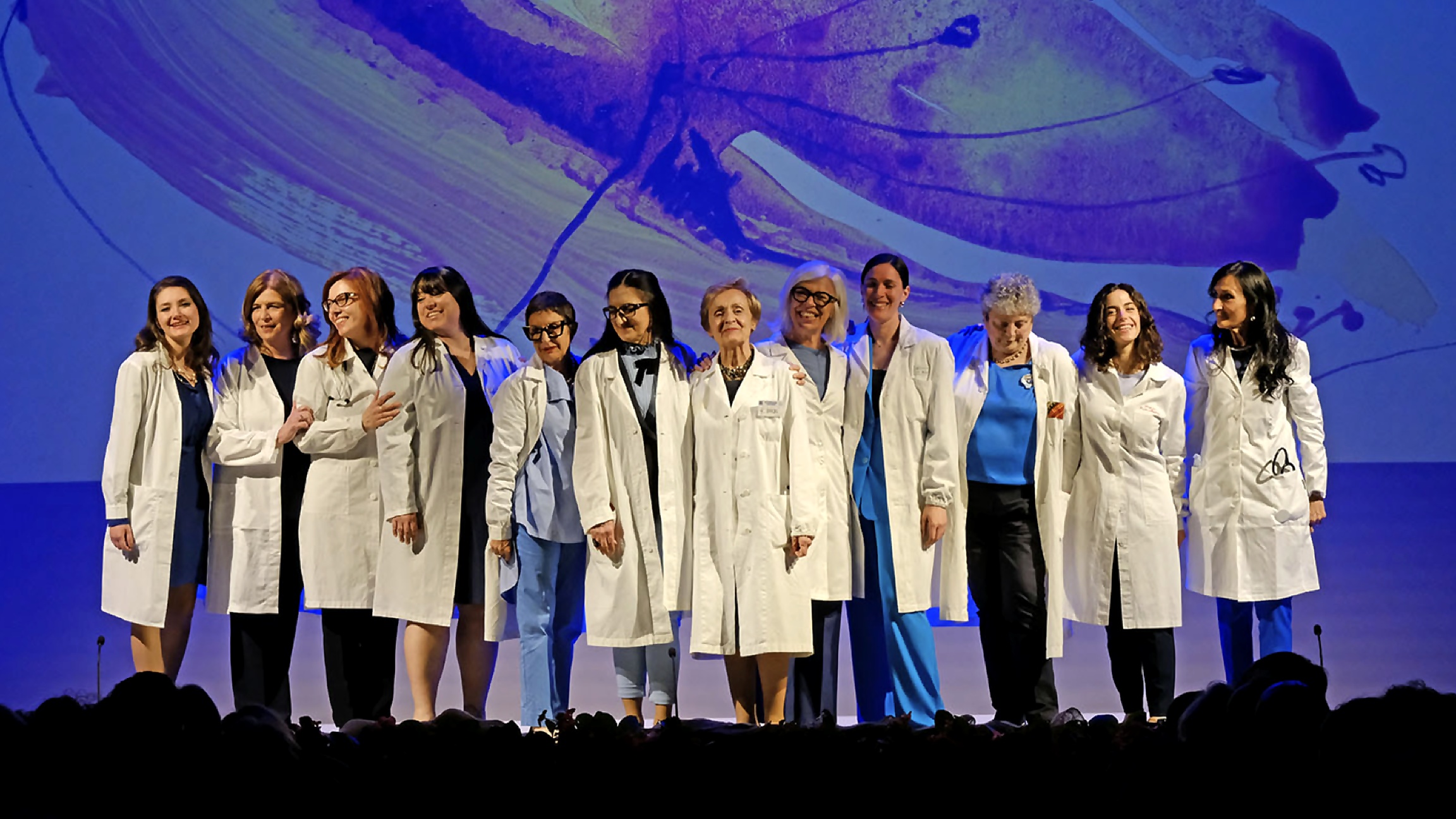
Le Medichesse: everyday stories in medicine… at the theatre
Paths, obstacles, different specializations—all on the same stage through the stories of fifteen female doctors: this is where Le Medichesse begins, a theatrical performance that brings to the stage the challenges that a woman physician must face today.
"The theatre allows us to speak with irony but also seriousness about important issues, because there is an emotional involvement from the audience," explained Dr. Daniela Gianola, specialist in endocrinology and metabolic diseases and Vice President of the Italian Association of Women Physicians (AIDM, Bergamo section), as well as one of the performers in Le Medichesse.
How did the performance come about?
Le Medichesse was born from the desire to speak to ordinary people rather than to medical experts (we “medichesse” are used to giving talks at conferences whose audience consists only of fellow doctors). Together with Silvia Barbieri (the director of the performance, ed.), we asked ourselves: ‘Could theatre be the right place to talk about this? Why not!’ Thus, the writer Adriana Lorenzi collected the biographies of twenty-seven female doctors who took part in her autobiographical writing workshop, and fifteen of us decided to go on stage and transform our professional and personal stories into a work made of narration and dance. The premiere took place in April 2025 in Parma, the city where Chiesi Farmaceutici is based (an Italian pharmaceutical company very attentive to inclusion and social issues), the main sponsor of the project. We achieved a sold-out performance and great recognition from the audience, which none of us had expected. In May 2025, the performance in Bergamo also sold out two shows in the same day; in October, the third performance took place as part of the Bergamo Science International Festival, and 2025 closed with a performance (also in October) in Pavia at the prestigious Teatro Fraschini, thanks to the commitment of the AIDM section in Pavia.
The performance stages the everyday life experienced by the female doctors, as well as the gender stereotypes that women face every day in the healthcare system. What are the main stereotypes the work seeks to dismantle?
In this performance, from doctors we become actresses, dancers, storytellers of real professional and personal experiences: nothing is invented, and this aspect, in my opinion, is the strength of the work because the audience can see what lies beneath the white coat. As with any woman in any profession, there are joys, sorrows, successes and failures, and exposing all of this to the audience creates deep empathy. But women must face an additional challenge, namely finding a balance between professional and personal commitments, and this is one of the main themes we bring to the stage. Then there is everything related to career advancement, because even in the medical world women must always prove something more compared to their male colleagues. Unfortunately, this happens in all work contexts. Another very common thing for female doctors, especially younger ones, is being called “miss” even when wearing a white coat, or being mistaken for nurses because it is still believed that doctors are only men. The data, however, tell us that 70% of this year’s medical school enrolments were female students, and for this reason I believe that in the future medicine will increasingly be made by women.
Another central theme of the work is sisterhood as a resource: what did it mean for you to work with other colleagues on a project that goes beyond your everyday professional context?
None of us is an actress; we are of different ages (from newly graduated doctors to retired doctors) and different specializations: we are fifteen completely distinct individuals, and we had to learn how to act on stage, something none of us had ever done before. So it was not easy for any of us, but we all committed ourselves to achieving a common goal, namely communicating our emotions to the audience. We spent many weekends together with the director and assistant director learning the script, how to get on and stay on stage, how to move and coordinate with each other. This work required a lot of energy, physical but above all mental. After all, we tell very intimate stories that influenced our choice to study medicine, stories that left an indelible mark (sometimes even a scar) on our hearts. The power of these narratives created strong bonds: each of us shares the others’ stories, makes them her own, identifies with the other’s account. We have become a group of friends, no longer just colleagues, and this means that when we rehearse we are happy to be together, we have fun… but we become serious again for the performance! And what about Igea: she is the only woman on stage who is not a “medichessa”, the only non-professional actress we adopted, and she has adopted us. Igea draws strength and emotion from medicine which, since the time of the goddess Hygieia (the Greek goddess of health), is not limited to the medical act of curing disease but represents an art in the care of the patient as a person.
With Le Medichesse, the aim is to convey a message of passion and enthusiasm for the profession to younger female students. What would you like to say to tomorrow’s female doctors?
Returning to how the performance was born, the very first idea was to pass the torch to the new generations, to the young women who will choose this profession. The choice of studying medicine must be guided by the passion to become a doctor, by the desire to help those who suffer, those who need care; those people who are devastated by illness, which often also negatively affects family and relationships. The path to becoming a doctor is very long and requires sacrifices and renunciations at a stage of life (between 20 and 30 years old) when one usually experiments and lives life to the fullest. For this reason, if there is no passion behind this life choice, difficulties and obstacles may become insurmountable and, even if one achieves graduation, it may happen that the doctor is a good professional but lacks that extra something that makes the difference in being a “medichessa”. And this is exactly what we want to convey with Le Medichesse: if there is passion, there is everything.”