
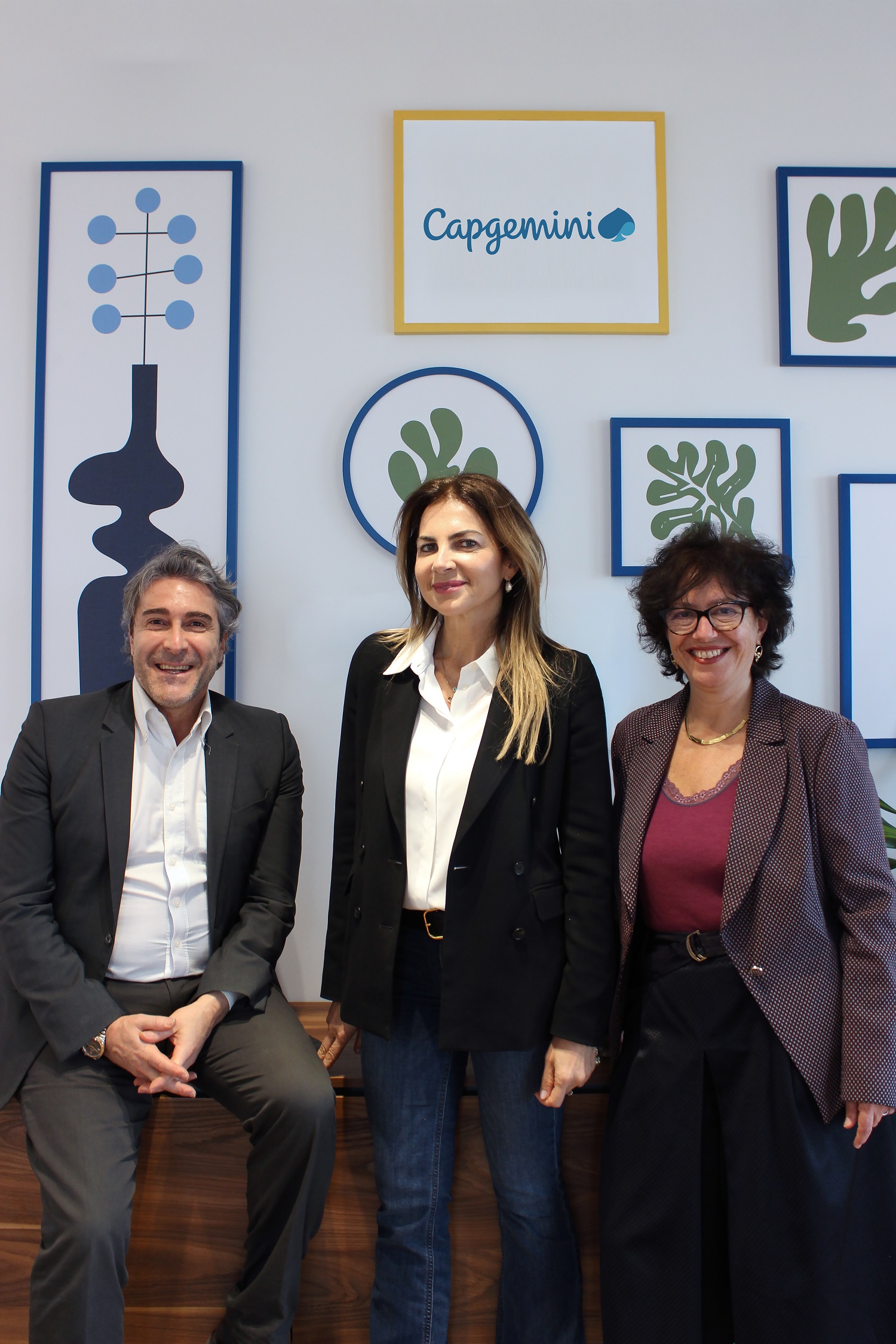
A digital future designed for everyone
Making everything accessible
Capgemini considers digital accessibility a cultural and social responsibility, even before it is a regulatory obligation. At a strategic level, what does making this choice mean? Umberto Larizza, Managing Director of Capgemini Invent in Italy, explains: “For us, it means taking on a commitment that starts from within. Being among the first in Italy to introduce the role of Chief Accessibility Officer within the company is precisely a sign of this approach. Our first step is to make everything we use daily accessible. If the Capgemini ecosystem works for everyone, we can more credibly guide clients and partners in the same direction. In this way, accessibility stops being a one-off intervention and becomes a true methodology, also capable of increasing the sustainability and attractiveness of workplaces, especially for younger generations.”
With this perspective, within Capgemini Invent, in the context of its frog business unit—the Global Business Line dedicated to strategy consulting, design, innovation, and transformation—the international Accessibility Hub has been developed, offering companies an integrated set of services across the entire value chain: from governance definition to inclusive design strategies, from technological adaptation to regulatory compliance, all the way to phygital experiences.
“Our goal is not only to ensure compliance with European and Italian regulations, but to help organizations transform accessibility into an identity and competitive element,” Larizza emphasizes. “In this sense, Capgemini’s role goes beyond consulting: we help define standards, directions, and visions for the future of digital accessibility, placing values, people, and social responsibility at the center.”
Accessibility is also a driver of competitive advantage, and for it to become a paradigm shift, certain precautions are necessary. Larizza notes: “Many organizations approach accessibility with a defensive mindset, believing they are compliant: they limit themselves to fixing a few web pages or meeting minimum compliance requirements, without a broad, long-term vision. The result is a series of spot interventions that do not truly change the user experience. Our work consists of guiding them toward a completely different model: transforming systems and processes so they become adaptive and inclusive by definition. This involves design, continuous touchpoint analysis, data-driven measurement (also through advanced AI techniques), and constant monitoring of solution effectiveness.”
Accessibility and the customer journey
How, then, does accessibility take shape within a company like Capgemini? Marta Marchionni, VP frog Italy, explains: “People’s experiences today move fluidly between digital and physical environments. For this reason, we design customer journeys that ensure continuity and accessibility at every touchpoint. Accessibility is not just about a website or an app: it is a building constructed over time, starting from design, running through the entire development chain, and reaching governance. It is a continuous process that requires planning, methodology, and above all a shift in mindset: accessibility is a structural commitment that evolves over time. The work of our teams integrates digital and industrial design skills: not only interfaces, but also ergonomic physical devices, tested with real users to ensure simple and consistent interaction throughout the journey. We support companies in building internal capabilities, defining strategic visions and operating models that embed accessibility into processes, policies, and roles, involving every level of the organization. The result is a systemic approach that makes accessibility an integral part of how things are designed, rather than a requirement to be checked afterward.”
Within design processes and digital experiences, AI is increasingly present, a true “powerful accelerator for making many types of content more usable,” as Marchionni highlights. “Think, for example, of the ability to extract information from complex documents or simplify everyday operations for people with different needs. This is a tangible value that we are already applying in various projects, from financial services to the design of tools and interfaces for retail chains.”
At the same time, AI and accessibility are not synonymous. “Applying technology to a website, app, or hardware interface—even when based on responsive AI—does not automatically make the service accessible. These tools do not replace the need to design an end-to-end accessible service by design. Technology, although advanced and adaptive, still cannot independently meet user needs because it lacks discernment regarding usage conditions,” Marchionni explains.
In this context, language represents one of the most delicate areas. “An AI-based system, if not properly trained and supplied with appropriate data, can introduce distortions, biases, or uncontrolled hallucinations following imprecise inputs, which can negatively affect comprehension and inclusivity of use. For this reason, we are conducting detailed research and risk assessment projects on the impacts of AI across the entire user experience value chain. Text-to-speech conversion, images with captions and descriptions, and texts interpreted in sign language are just some examples of how we are developing AI as an accessible assistant within our research center.”
Training
In the direction of more conscious use of digital goods, products, and services, Capgemini has invested heavily in internal training. Alessandra Miata, CSR Director of Capgemini Italy, states: “All employees are involved in accessibility-focused programs, with increasing levels of depth depending on their roles, to spread awareness and concrete skills in inclusive design and the creation of barrier-free digital experiences. It is very important to understand that developing accessible solutions is not only the job of design and digital development specialists, but a way of thinking that must permeate all roles and functions within the company. For this reason, at Capgemini all employees are trained to understand and apply digital inclusion techniques in all their activities.”
This way of working also has an impact beyond company boundaries. “The arrival of AI, and particularly generative AI, greatly amplifies both opportunities and responsibilities,” Miata adds. “For this reason, we have developed an AI Code of Ethics that defines principles and guidelines for integrating ethical considerations at every stage of the algorithm lifecycle and the services we offer to clients. It is a framework designed to promote transparency, fairness, accountability, and a human-centric approach to the development and use of intelligent systems.”
The Capgemini Research Institute report “Overcoming the Ethical Dilemma: A Practical Guide to Implementing AI Ethics Governance” highlights that companies must equip themselves with robust governance structures capable of anticipating risks such as bias, lack of transparency in decision-making, excessive reliance on models, or potential psychological and social impacts. AI ethics is not a constraint, but an enabler of scalability, trust, and resilience: it requires executive-level ownership, interdisciplinary collaboration, and continuous integration into transformation programs.
“We apply this approach also in the area of digital inclusion, one of our global CSR priorities: we want to reduce the digital divide, spread skills, and make innovation accessible to everyone,” Miata notes. “It is part of our ESG goals, because technology can truly be a factor of social cohesion only if it is designed and governed responsibly. The role of a technology company like ours is twofold: to guide the market through accessible, inclusive solutions that meet the most advanced standards, and to promote a culture of conscious AI use that combines innovation, ethics, and positive social impact. Only in this way can we build a digital future that truly works for everyone.”