
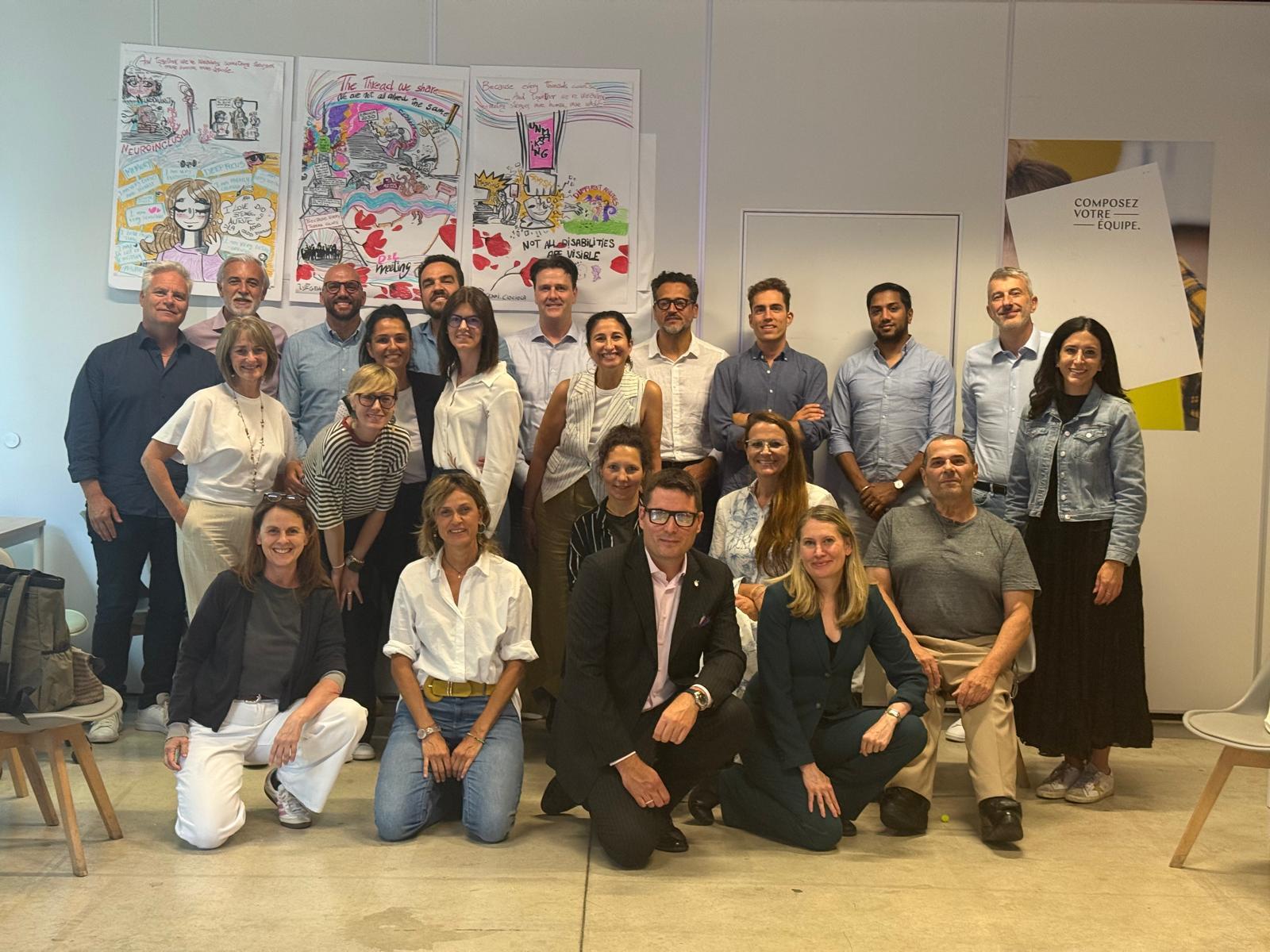
The thread we share: practicing neuroinclusion
Last June, Chiesi organized a global internal meeting titled The Thread We Share, with a focus on neuroinclusion. Why?
AC: This choice stems from the natural evolution of a journey that began in 2019 and is fully aligned with our work on inclusion, which at Chiesi we have recently defined through the acronym U&I (Uniqueness and Inclusion), to shift the focus from differences to the unique strengths of each individual. We realized that, as in the rest of the world, there is a plurality of cognitive styles within the company, while organizational systems are largely built around neurotypicality. This is particularly relevant in our scientific field, where data show a significant presence of diverse cognitive styles. From this came a fundamental question: do we truly want to be an inclusive company capable of valuing all forms of intelligence, or are we willing to give space only to the most common cognitive styles? The meeting was born from this question and from the desire to explore what it really means to make an organization inclusive for all cognitive styles. The chosen title, The Thread We Share, reflects exactly this: we are threads, each with a different color and texture, that meet and intertwine. When the right conditions are in place, every nuance is enhanced and a beautiful pattern emerges. Over the three days of work, we experimented with a design by all for all approach, moving beyond labels and focusing on the coexistence of different styles within a broader understanding of the complexity of neurodiversity. This was possible because the experience was co-created with neurodivergent people: openly neurodivergent colleagues, consultants such as Tommaso Davi from NeuroSive, and the artist Genni Ciociola. At the end of the meeting, another equally genuine question emerged: now that we have experienced and better understood neuroinclusion, do we really want to work in this direction? The answer was yes. And it is precisely this authenticity – a real question followed by a conscious choice – that made the meeting different from others held in the past. What worked best? Two things: working with a neurodiverse community (the real and concrete coexistence of different intelligences) and, as a result, the impact generated. There was a widespread interest in exploring not only how to create more inclusive conditions internally, but also how to rethink business processes and the way we operate externally. We are still at the starting point, but we are moving in that direction, with growing awareness that is closely connected to our core business.
What were the first actions implemented after the meeting? And what was the impact on people at Chiesi?
ST: Certainly the Sounding Board, a global group of colleagues involved in strategic company projects who bring their neurodivergent perspectives, making the principle of design by all for all tangible. It is a free and genuinely inclusive space, aimed at fostering dialogue between different ways of thinking to generate innovation and impact. From this approach, real actions have emerged. One example is the project promoted by the Chiesi Affinity Networks (our ERGs – Employee Resource Groups), in particular the network dedicated to disability, to make clinical trial information leaflets more readable and accessible for people with dyslexia. The work was carried out in collaboration with the Italian Dyslexia Association, focusing on aspects such as typeface, font, and text layout. The new version is currently being tested, with positive feedback from all users, not only those with dyslexia. It is an ambitious project, as it also involves engaging with regulations that were not originally designed with a by all for all approach, but it has the potential for a very broad impact. For this reason, one of the 2026 KPIs concerns the number and quality of projects generated by the Sounding Board, in order to measure their impact. Another important initiative was the realization of Meeting Galateo, developed with the direct involvement of the Sounding Board. This is a rethinking of how meetings are conducted at Chiesi, through the lens of wellbeing, effectiveness, and accessibility, with particular attention to how neurodivergent people experience these spaces. This process led to the definition of principles that can be applied in everyday practice to make meetings more inclusive. For example, in the first version of Meeting Galateo, the check-in question often suggested to create connection at the beginning of meetings was «How do you feel?». Through dialogue with the Sounding Board, it emerged that this question does not always make everyone feel comfortable. An alternative that was proposed is: «What do you need to perform at your best in this meeting?», maintaining a space for positive and inclusive sharing for everyone involved. Finally, there is the global awareness program, starting in 2026, designed to scale up initiatives already present within Chiesi. The goal is to provide clear information on neurodiversity and practical tools to interact more consciously, for example around meeting etiquette and language, while deepening understanding of these topics and supporting the wellbeing of all.
An important part of this journey was your decision, Matt, to share your neurodivergence within the company. What were your expectations when you disclosed it?
MW: When I disclosed my neurodivergence at Chiesi – I was diagnosed with Attention Deficit Hyperactivity Disorder (ADHD) and Obsessive Compulsive Disorder (OCD) – I did so because I felt safe. Consequently, I expected to be accepted, to feel comfortable, to be supported and not to be judged. Most importantly for me, I was desperate to be able to be my authentic self. For years, I had learned to mask. Disclosure was about throwing away my protective shield. I was not seeking special treatment, but rather understanding – of how I feel, how I work, why I work the way I do and how that can be both challenging and valuable. I hoped that openness would lead to more honest conversations – and that by being visible, I might also make it easier for others to be open in their own time.
What has your experience been with the Neurodiversity Sounding Board?
MW: The neurodiversity sounding board is a practical expression of Chiesi’s commitment to be inclusive of all people and all thinking styles. It brings together committed colleagues who have a real connection with neurodiversity. It will provide input on projects, policies, processes, workspaces, environments, systems, platforms and tools which are or may be used at Chiesi. Its recommendations will directly inform and strengthen Chiesi’s design and inclusion efforts. Although it is early days, I already have very high expectations for the sounding board, both in the value it can add to decision-making and the role it will play in helping Chiesi continue to build a workplace where everyone can truly thrive. The sounding board has also provided an opportunity for colleagues with a common interest to meet and share experiences in a safe, trusting environment.
Tommaso, you were among the consultants involved in the Paris meeting. What impact did participating have on you?
TD: Participating in a meeting of this kind was a great opportunity for me to bring value to my work and personal research aimed at fostering neuroinclusion within organizations. It was also very meaningful to be able to act as a point of reference from the very beginning of a process that chose to be guided by a spirit of service. At an international level, the experience was unique: it made it possible to work not only on best practices and on the cultural compass to use when addressing neuroinclusion, but also on the business value of these initiatives and their relevance to the organization’s strategic priorities. The work was structured as a collaborative and co-creative journey. Together, we built a plan, a roadmap, that could offer the organization a clear direction to follow. Neuroinclusion operates on many levels, and the process aimed to address them in a systemic way, so that the tools developed could be adopted by Chiesi over time.
What were the main challenges, and what aspects were easier to implement?
TD: The most challenging part was, from the very beginning, gaining a clear understanding of how best to support the team throughout the activities, starting from a key question: how do we design an experience that is meaningful from the outset, and how do we do so within a very tight timeline? The easiest part, on the other hand, was creating a culture around the event. It was an experience that enabled effective co-creation and made it possible – also through the use of digital tools – to identify inclusive ways of engaging all participants. The goal was to encourage contribution from everyone, to put shared tools on the table, and to ensure that participants not only used them but felt like active contributors and protagonists in the process. In this sense, the metaphor The Thread We Share played a central role: the shared thread brought everyone together, both during structured activities and in informal moments, generating powerful emotional connections and a widespread willingness to open up. I did not expect it to be so immediate, but from the very beginning a sense of psychological safety emerged, enabling authentic dialogue, active listening, and non-judgmental sharing. Everyone present engaged with this mindset. The work was also grounded in the application of the Inclusion Pyramid framework by Maureen Dunne, neuroinclusion expert. This model allowed us to approach neuroinclusion not only as an area of intervention, but as a lever to foster an open, innovation-oriented mindset within the organization, while also providing a clear structure on which Chiesi can build its future path.