
A bridge between technology and emotions: when AI becomes inclusive
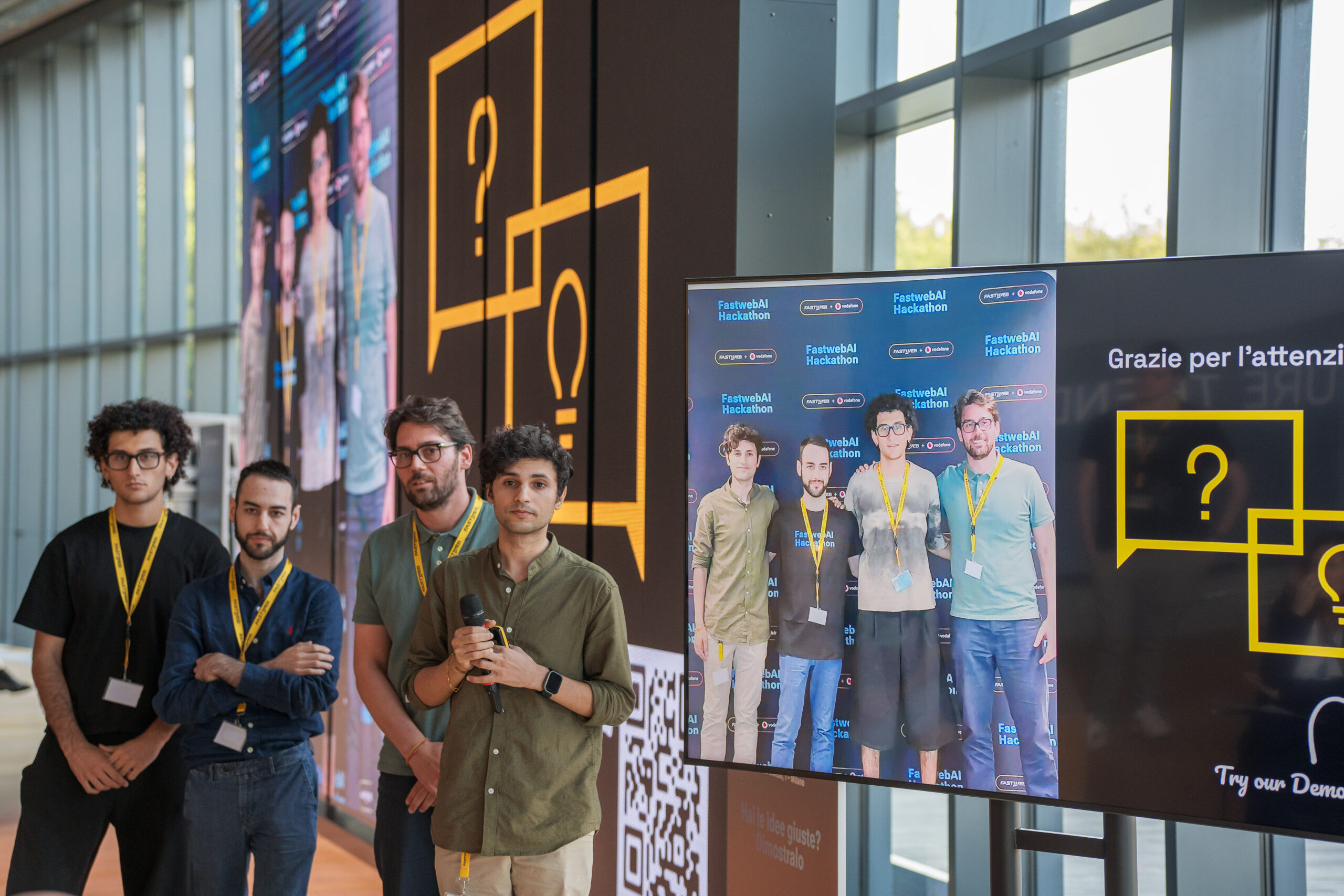
Here, through the voices of the winning team—Lorenzo D’Amico, Michele Vitiello Bonaventura, Marco Lecci, Salim Benhamadia—and of juror Barbara De Micheli, Social Justice Area Coordinator @Fondazione Giacomo Brodolini, is the heart of this story that brings together technology and humanity.
Michele, how did the idea for this app come about? What personal story or observation inspired you to focus on neurodivergence?
The idea came from the need to create a solution that would stand out from those proposed and developed by the other teams. Over the past year, I started to take an interest in topics related to neurodivergence, particularly level 1 autism. For a university course, I had developed an app capable of recognizing a primary emotion based on a note entered by the user, generating introspective quizzes, and exploring personal experiences through a chat guided by artificial intelligence. So we decided to address a broader issue, present in level 1 autism but not limited to it: alexithymia, the difficulty in recognizing one’s own and others’ emotions. We wanted to create a simple, intuitive tool that would allow users to find a safe space for decompression, where they can regulate themselves in a protected environment. A tool that could also be integrated into therapy, useful for providing a more complete view of the patient—distinguishing between how they communicate during sessions and the thoughts they have daily, and thus better recognizing masking.1
Marco, during the 24 hours of the hackathon, how did you collaborate as a mixed team? What strengths did diversity bring to your way of working and problem-solving?
During the 24 hours of the hackathon, we worked as a truly interdisciplinary team, trying from the very beginning to value each person’s skills. This allowed us to tackle the problem from multiple perspectives, both theoretical and practical. The diversity within the team was a real strength: it prevented us from getting stuck in a single viewpoint. Ideas often emerged from discussions between different approaches (more theoretical vs. more engineering-oriented), and this helped us both identify better solutions quickly and correct initial design flaws. In practice, everyone tried to contribute actively, but the project was naturally driven by the more operational skills of Salim and Michele, who enabled us to turn ideas into something concrete within 24 hours.
Lorenzo, how did you use Fastweb Vodafone’s AI assets to translate sensations into emotions? Can you tell us about a “eureka” moment during development?
We used Fastweb’s computing power and Vodafone’s network speed to run several tools. Among them were Generative AI, which translates sensations or narratives into coherent reflections within the chat; Emotional Body Mapping, which captures user input, recognizes patterns from a database, and identifies emotions; and finally, an anonymous Community space for sharing and support. This is how users shape and track their profile. I still remember when, around four in the morning, unable to keep my eyes open, I decided to get some rest. About an hour later, I was woken up by Salim and Marco—they had just completed the debugging phase. The demo was ready, our idea had become real. We realized we weren’t just building tools—we were giving thousands of people, both neurodivergent and neurotypical, the opportunity to understand themselves. At that point, adrenaline took over, I pushed aside the sleep, and started preparing the presentation pitch.
Michele, what reflections did you make on the use of AI to support minorities or vulnerable groups? Do you think technology can really bridge inclusion gaps? How?
From the very beginning of the project, we believed that the true power of AI lies in its flexibility—its ability to adapt to and interpret each user’s unique signals, rather than standardizing them. Technology often imposes rigid pathways, but with EmotiSense we tried to build a bridge between code and emotions, making accessible what is difficult for many people to grasp. We believe that offering this kind of support is a decisive step toward inclusion. If in just a few hours four young people were able to bring this idea to life, it means that the gap between a need and its technological solution is shrinking.
What surprised you most about working on such an empathetic project? How did it change your approach to AI?
By reading scientific papers and using our own platform, we arrived at an unexpected reflection. We asked ourselves whether we, too, sometimes struggle to name what we feel every day, to recognize its nuances. We realized that alexithymia is not just a diagnosis—it is a challenge that can affect many of us. This introspection radically changed our approach to artificial intelligence. We understood that having such a powerful technology at our disposal means that, to truly make a difference, we must use it creatively in the service of everyone.
Barbara, as a juror of the hackathon, what impressed you most about this project among all those presented? Why did it deserve the Best Inclusion Project award, and what real impact can it have on neurodivergent people?
Among the many very interesting projects developed during the hackathon, this was the only one focused on differences and on addressing specific needs by proposing innovative solutions, incorporating attention to diversity from the very design phase. Technological solutions can be powerful tools for inclusion, but it is essential that those who design them develop the sensitivity to recognize that users may have specific needs, and the willingness and skills to understand those needs and propose appropriate solutions. The winning project demonstrated that it has, at least in potential, these characteristics. It also showed that, to be truly effective, inclusive technological solutions must integrate multidisciplinary expertise into their design—something that will necessarily need to be activated in the next stages of development. In this sense, the potential impact is very high, not only for neurodivergent people (and it would not be the first time that solutions designed for them also prove useful for neurotypical individuals).
At Fastweb + Vodafone, we believe that artificial intelligence is not just a tool for efficiency, but a powerful ally for inclusion. Projects like this hackathon remind us that true innovation arises when technology and empathy come together, opening doors for those who experience the world differently. It is a commitment that inspires us every day: to build a more human, inclusive, and brighter AI-driven future for everyone.
- A behavioral strategy that involves hiding one’s neurodivergent traits in order to imitate neurotypical behaviors and conform to social expectations ↩︎