
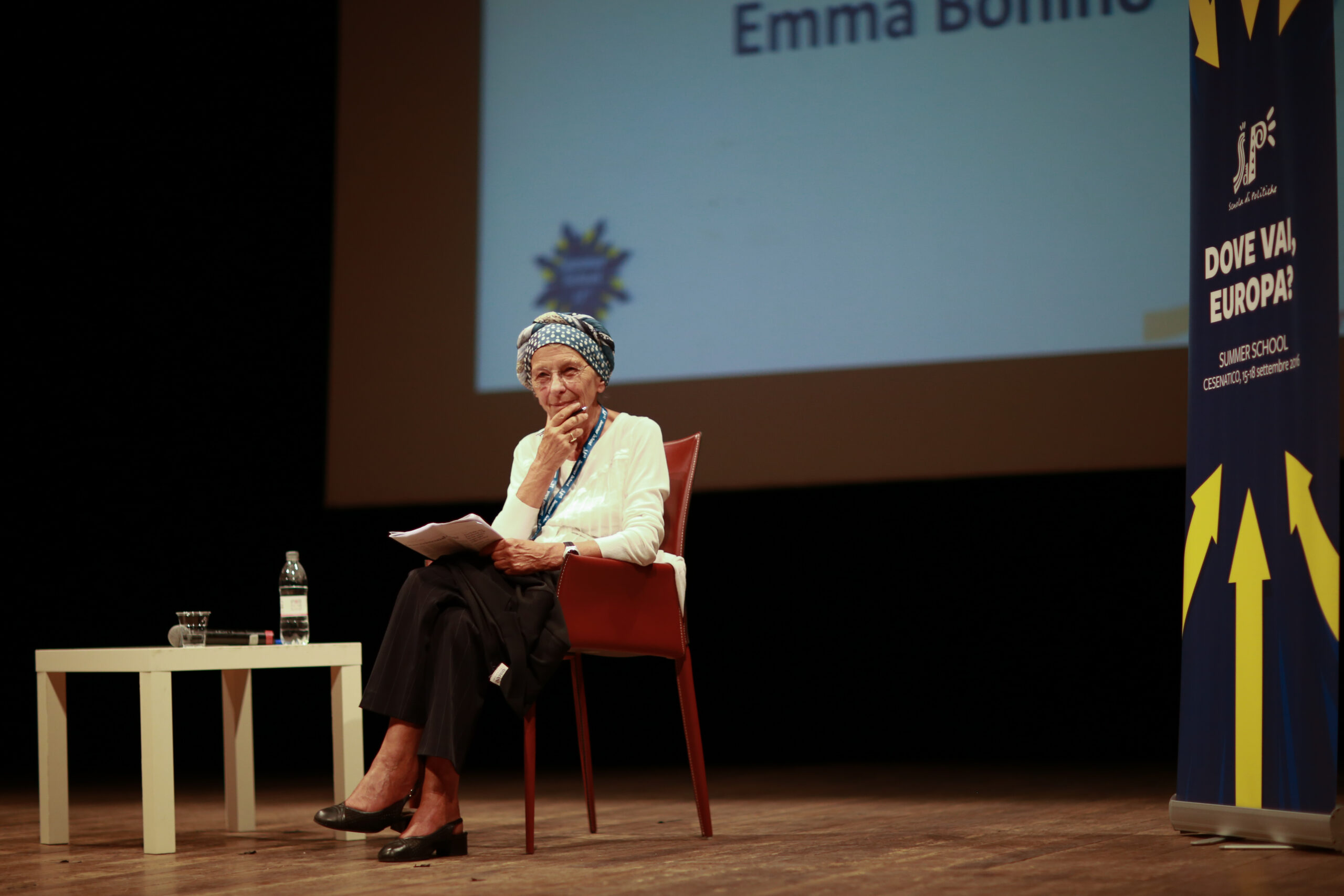
Emma Bonino, a life devoted to freedom
She spent nearly 50 years of Italian political history fighting, both inside and outside institutions, for controversial causes concerning issues that were often ignored or forgotten: abortion, divorce, contraception, self-determination, the rights of prisoners, end-of-life issues, the fight against the death penalty and female genital mutilation are just some of the issues that marked her long political commitment. Emma Bonino passed away last September 11, after a long battle with cancer that she never made an effort to hide, leaving a profound mark on the history of civil rights in Italy and a political legacy that goes far beyond party affiliations. Born in 1948 in Bra, between the hills of Roero and those of the Langhe, she graduated from Bocconi University in Milan and became involved with Marco Pannella's Radical Party at a very young age, beginning a decades-long partnership. First elected to the Chamber of Deputies in 1976, at just 28 years old, she would serve as a member of Parliament for several legislatures, as a Member of the European Parliament and European Commissioner, before going on to hold the positions of Minister of Foreign Affairs and Vice President of the Senate.
Tenacious, provocative, pragmatic and often divisive, she built her political activism around the painful experience of having an abortion, as she herself recounted. In 1974, the Rocco Code was still in force and abortion was considered a crime against the integrity and health of the race. After discovering she was pregnant, Bonino travelled to Florence, where she underwent an illegal abortion. There were no legal channels available, but the experience left a profound mark on her. “On the train back that night, I decided that never, ever again should any woman have to endure that humiliation,” she often recalled in later years.
It was during this period that she came into contact with the Radical movement and Adele Faccio, founder of CISA, the Information Centre on Sterilisation and Abortion, a network providing information and assistance to women, helping them obtain abortions in open defiance of the law. The stakes were high: women who wanted an abortion would have one anyway, but in secret. There were the mammane, who used rudimentary and highly dangerous methods such as knitting needles, and the cucchiai d'oro (literally, “golden spoons”), doctors who performed abortions behind the closed doors of private clinics, charging astronomical sums. It was a difficult battle: the Radicals organised high-profile acts of civil disobedience designed to reach the heart of public opinion. In 1975, like other Radical activists, Bonino had herself arrested, reporting her own involvement in organising abortions. In the following months, the battle continued in Parliament, culminating in the historic approval of Law 194, which, on 22 May 1978, finally legalised voluntary termination of pregnancy (IVG).
However, the law did not put an end to the question of self-determination, nor to the sometimes heated disagreements with part of the feminist movement with which Bonino had shared some of the battles of the 1970s. Women's rights nevertheless remained at the top of the Radical leader's priorities. In 1997, as European Commissioner for Humanitarian Aid, she organised a mission to Afghanistan to gain first-hand knowledge of the situation of women. Stopped during an official visit to a women's hospital in Kabul, arrested by Taliban militias and eventually expelled, upon her return to Europe she promoted the campaign “A Flower for the Women of Kabul”, which culminated on 8 March 1998 with initiatives in several cities around the world.
Immediately after the end of her term as European Commissioner, in the early 2000s, Bonino launched her campaign against female genital mutilation through the initiative “No Peace Without Justice” and coordinated a major political lobbying effort to secure ratification of the Maputo Protocol, adopted by the African Union in 2003, which establishes an absolute ban on this practice, later prohibited by a UN resolution in 2012.
But perhaps one of her most striking gestures, and one destined to remain in the country's memory for a long time, was her candidacy for President of the Republic in 1999. At the time, the Radical leader was 51 years old and, at least in theory, seemed capable of attracting support both from centre-left voters, who appreciated her campaigns for civil rights and women's rights, and from centre-right voters, who valued her staunch liberalism and her alliance with Berlusconi in the 1994 general election. Her candidacy was supported by an unprecedented electoral campaign aimed directly at public opinion, as though the country's highest office were to be decided by the electorate rather than Parliament. Today, what remains above all of that American-style campaign is its slogan: “Emma Bonino. The right man for the Quirinale.” A deliberately provocative play on words that overturned the stereotype according to which the authority and expertise required to lead the country were exclusively male prerogatives. Bonino was not elected, but the campaign helped bring the issue of women's representation at the highest levels of the State into public debate.
The issue of violence against women also featured in her public statements. In 2013, taking part in the international tour of Serena Dandini's travelling theatre production Ferite a morte (Wounds to Death), Bonino highlighted society's responsibility in tackling femicide. And ten years later, in November 2023, following the murder of Giulia Cecchettin, she addressed men in particular, shifting the focus from the protection of victims alone to the responsibility of those who must question the behaviours and culture that fuel violence: “Dear men, fighting violence against women requires you to take clear, specific and public responsibility. The time has come for you to mobilise and say enough is enough.”
Many of the women who came to pay their final respects at the lying-in-state, held at the Protomoteca Hall of Rome's Capitoline Hill, remembered this commitment too. Many of them were holding a rose. “She was a point of reference for us,” said her longtime assistant, Carla Taibi, on that occasion. “And yet today's young women don't know the women who fought for their rights.”