
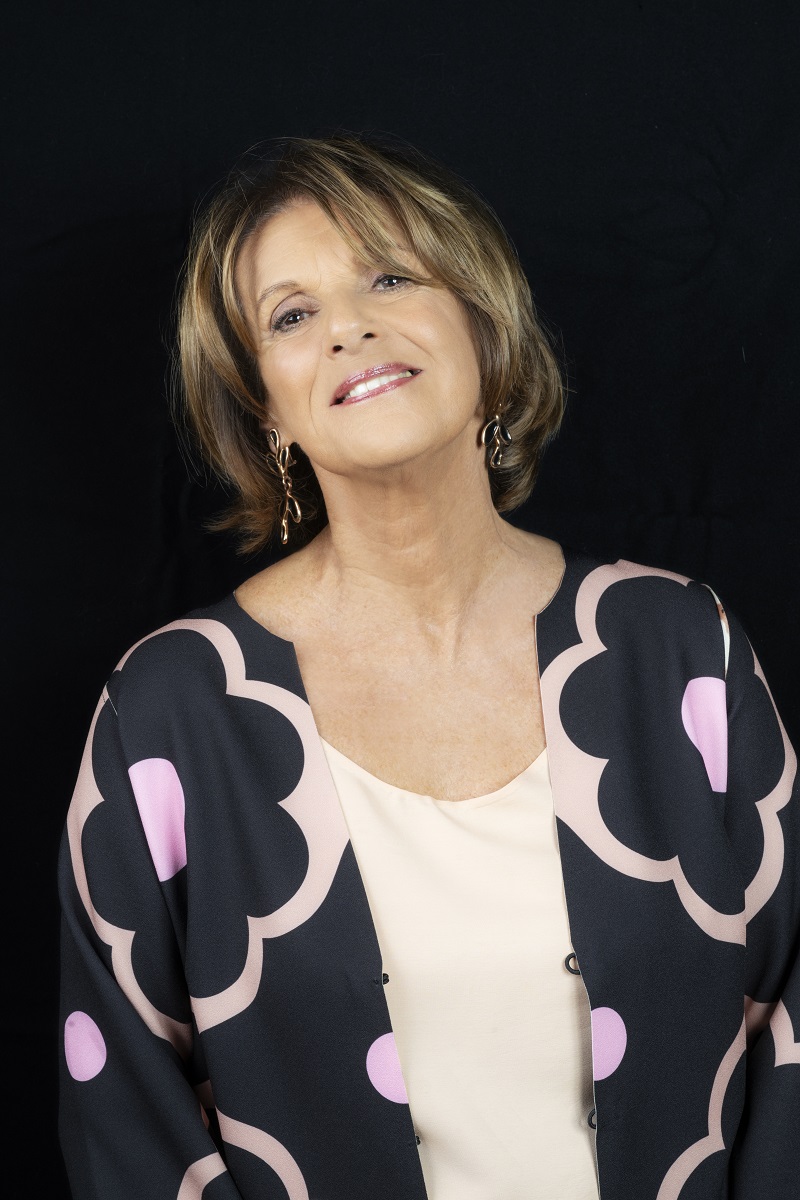
Lella Costa: «Violence against women is a men’s problem»
As an actress, playwright and theatre director, Lella Costa has always combined irony with civic engagement, bringing stories and characters to the stage that help us understand the contradictions of the present, with particular attention to women's rights, inequalities and gender stereotypes. Her work has also addressed gender-based violence, an issue that today, more than ever, calls men into question.
Othello, di precise parole si vive, which she recently brought back to the stage with Gabriele Vacis, 24 years after its debut, ultimately tells a story that, if we read about it in the newspapers today, we would recognize as a case of femicide. What prompted you to bring this production back?
There are stories so perfect, like those of Shakespeare, that whenever they are told, they manage to reach us. Although they do not refer to current events in the strictest sense, they speak of something that is perpetually contemporary. The encounter between a highly qualified foreigner and a young Venetian noblewoman sounds like a story from today. Gabriele Vacis and I realized that when we first staged the production, the word femicide had not yet entered common usage. Naming things is not enough to make them disappear, but having a term with which to recognize and describe them is already a great deal. There is also the issue of the manipulation of words: Othello is a foreigner who has learned the language of Venice and speaks it with devotion and respect; he would never lie. Iago, on the other hand, who was born into that language, uses it ambiguously and equivocally. Today, too, we should pay close attention to the way words are used.
In 2012, you took part in Ferite a morte, by Serena Dandini, a play about femicide based on real-life stories. Today, fourteen years later, what has changed in the way violence against women is portrayed?
One of the merits of Ferite a morte was that it portrayed femicide in a somewhat surreal way, without relying exclusively on a dramatic tone. Some of the stories we brought to the stage are funny, even grotesque. This puts the audience at ease, and when the story reaches its crucial point, the impact is even stronger. It is a way of showing the apparent normality of certain situations. Violence can also come from people who, until that moment, were considered beyond suspicion. It is a story we hear about constantly.
Not all femicides receive the same media attention. What makes one case more newsworthy than another?
I think proximity and the unpredictability of the events also play a role, especially when the people involved could be our children or their schoolmates. When the perpetrator is a friend, a boyfriend, someone you would never expect, the story feels much closer to home. It is difficult, however, to provide a precise explanation for media dynamics. Sometimes certain events remain in the spotlight because particular individuals capture the public imagination or collective sensitivity. Take the Garlasco case, for example, which has never been discussed as a case of femicide, perhaps partly because the murder took place before the term entered common usage. A very young woman was killed, yet attention focuses on guessing who is guilty and on the clash between those who believe in the suspect's innocence and those who believe in his guilt.
You belong to a generation that experienced major transformations in relationships between men and women. Looking at younger women, what differences do you see in the way they talk about feminism, violence and relationships?
I find it difficult to talk about young people as though they were one single group, a homogeneous mass united only by age. There are young women and men who are socially engaged, aware and attentive to the struggle for rights. And there are others, such as those in the world of influencers, who are perfectly aligned with the mainstream. Feminism has taken, and continues to take, many different forms. I do not necessarily identify with all of them, but I think it is important for young women to find their own ways of expressing themselves and getting involved. Moreover, some achievements that we once thought were secured forever are being challenged and threatened once again.
What exactly are you referring to?
I am thinking of women's freedom of choice and the recurring debates surrounding Law 194. Abortion is the most painful of rights, and yet accessing it can still be extremely difficult for women, especially young women and perhaps those from abroad. If there were another referendum on divorce and abortion today, could we be sure of the outcome? The hypocrisy of a double standard is becoming increasingly widespread. Some things are acceptable, as long as nobody talks about them, as long as they do not become a right for everyone.
According to the latest Istat data, most cases of sexual violence experienced before the age of 16 occur between the ages of 11 and 16. Furthermore, more than 58% of victims have never told anyone about the violence they experienced during childhood. What do these figures tell us about the society in which girls and boys are growing up?
We live in a country where, until 1996, sexual violence was considered a crime against public morality rather than against the individual. We are afraid to report it because the transition from victim to accomplice can happen in an instant. We do not feel sufficiently protected or defended. Just think of the trials in which it was argued that a woman could not have been raped because she was wearing jeans. It hurts me to see, during trials involving gang rape, mothers defending their sons at all costs, sometimes even turning against the victims. There is another question I often ask myself: why, when we talk about violent boys, do we only call their mothers into question, accusing them of having raised them badly? Why are fathers automatically absolved? Let us start here. Violence against women is a men's problem. Let us say it openly: men should be the ones to speak up, and each person must take responsibility for their own part.
After so many years of working on this issue, what gives you the most hope today?
First of all, the fact that people are talking about it. Talking creates an opportunity, a network and a space where people can be heard. I hope that women involved in these situations, especially younger women, will feel more protected and supported. And I hope that men will begin to take responsibility for this pathology that runs through the relationship between masculinity and femininity. It is the only way to change things. If emotional education and a culture of relationships become central to people's development, perhaps we will manage to get through this narrow doorway. It will not be easy, but we have to try.