
CADMI and the Prada Group: from awareness to autonomy
CADMI (Casa di Accoglienza delle Donne Maltrattate Milano) is the first anti-violence centre established in Italy, founded in 1986 by a group of women belonging to the feminist movement. “Reflecting on certain issues brings one significant fact to light: the violence experienced by many women in intimate or close relationships,” explains Catia Feoli, Head of Communications and Fundraising at CADMI. “This awareness marked the beginning of the process through which gender-based violence began to emerge as a recognised issue in our country.” At the time, these women were courageous in bringing a phenomenon that was still largely unrecognised into the public eye and in creating a support pathway for the women experiencing it.
From 1986 to today, CADMI has welcomed 38,000 women. In 2025 alone, 1,095 women who had experienced violence, or people close to them, turned to the association for support. These were often colleagues who had noticed an abusive situation in the workplace.
There are around 600 active support pathways designed to help women through psychological support, legal advice, shelters — nine confidential-address facilities in the Municipality of Milan — and a dedicated area focused on employment and economic autonomy, through training, often also delivered via corporate volunteering, and concrete employment opportunities.
The second objective CADMI works towards is cultural change. “We started with an Istat figure: one in three women in our country experiences some form of violence. The exercise we try to undertake is to count how many women are in a given space and how many of them may have experienced this situation: what can we do to support them, but also to change the culture?” explains Feoli. Every year, thousands of people are reached through schools and universities, but the work also involves adults. “Involving the entire population in cultural change is both feasible and necessary.” And this also concerns businesses.
The partnership with CADMI began with the Prada Group's achievement of gender equality certification in 2025, a process requiring detailed analysis and work on KPIs, policies and procedures. At the end of this phase, the Group considered how to introduce additional safeguards for workplace safety and to combat gender-based violence, with the aim of ensuring an environment in which people can place their full trust.
The Prada Group therefore wanted to involve CADMI directly within the company, drawing on its experience and resources to provide everyone working across the Group with the tools to recognise violence and to offer or seek help when needed.
As Rosa Santamaria Maurizio, Chief People Officer of the Prada Group, explains: “Working alongside CADMI has allowed us to draw on the experience of people who have an in-depth, first-hand understanding of the dynamics of violence and discrimination. This journey has given rise to a clear commitment for our Group: to bring this awareness into our workplaces, turn awareness into action, and provide everyone who works with us with practical tools to recognise and combat every form of violence and discrimination.”
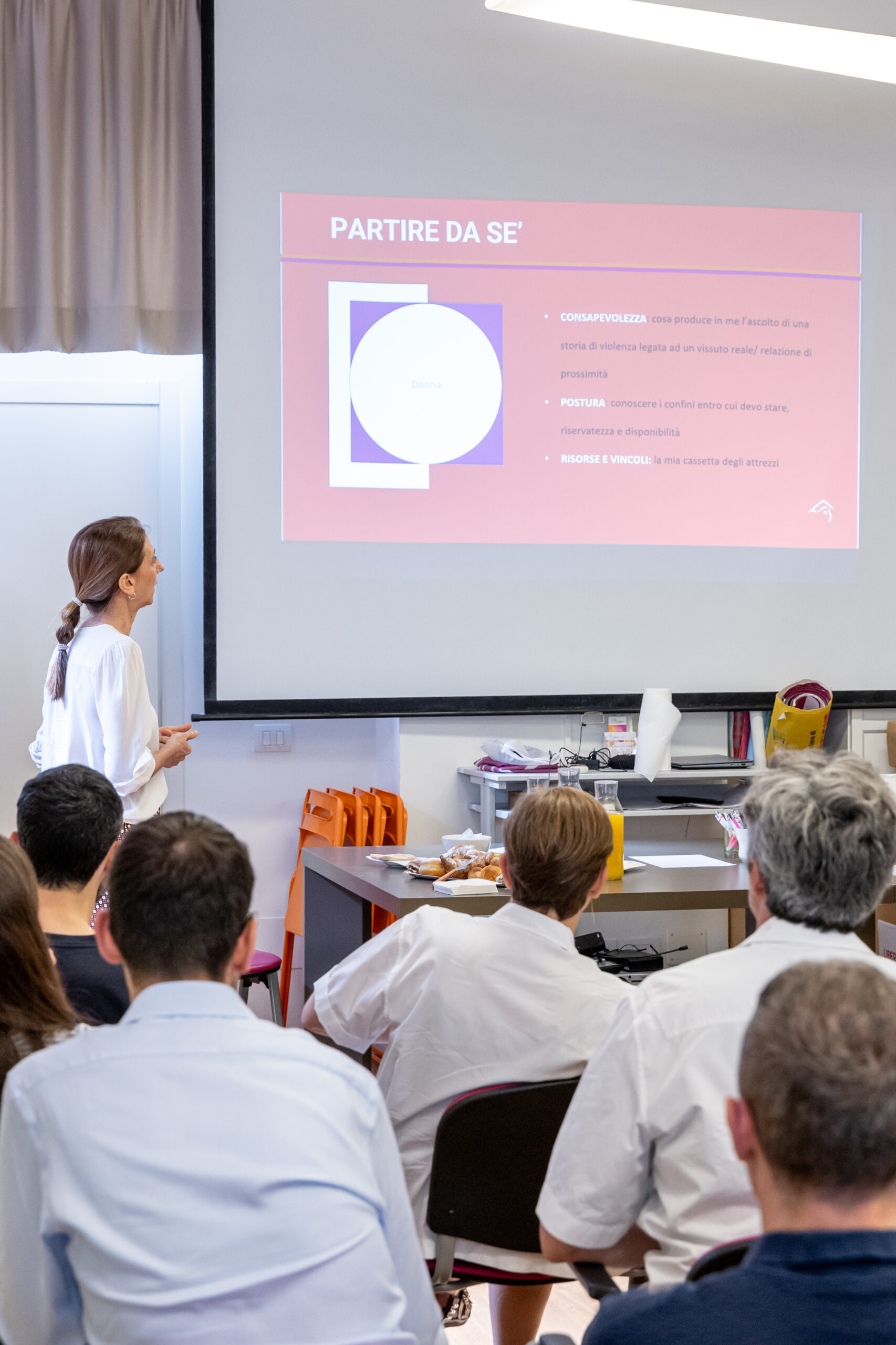
This marked the beginning of a journey that the Prada Group intends to continue, starting with the fundamentals: defining what violence is and the different forms it can take, so that essential knowledge can be widely shared and firmly established. From there, the discussion turned to the concept of workplace safety and the role of HR, so that it can provide appropriate support to women experiencing violence and, when necessary, refer them to an anti-violence centre. Specific training was therefore organised for HR professionals, who are often the first point of contact for people experiencing abuse and deciding to speak about it within the company.
The 2026 Project includes a programme made up of several initiatives. On the one hand, there is a cross-functional cultural module featuring three webinars aimed at all employees of the Group in Italy, designed to raise awareness of male violence against women. On the other, there is a strategic module dedicated to the HR team, requiring ongoing training to manage situations of violence involving female employees with the necessary expertise. This module aims to build a shared internal culture, providing the HR team with the appropriate tools and language to recognise violence and welcome and support women without creating isolation or stigma.
The project also addresses the cultural dimension, with the aim of building an environment in which dynamics of abuse and domination are not normalised. This is essential work, because the journey of women experiencing violence is full of obstacles, including simply finding the words to talk about what they have endured.
Feoli adds: “There is still a very strong stigma surrounding women who experience gender-based violence. People often believe that they have somehow ‘got themselves into’ an abusive situation. We are surrounded by terms such as emotional dependency and toxic relationship, which give us the impression that we can easily recognise violence. They make us believe that it could never happen to just anyone.”
It is therefore important that women experiencing violence can speak about it without shame and ask for help. Another problem is that gender-based violence is often associated exclusively with physical violence. “When a woman experiences psychological abuse or stalking — which is an extremely serious and high-risk form of violence — for example, she may not recognise herself in the common representation of physical violence and may find it harder to acknowledge that she is experiencing abuse,” Feoli points out. This is why it is essential to understand how violence develops and the different forms it can take, to address the stigma experienced by women and to talk about the cycle of violence.
Violence, in fact, follows a cyclical pattern, with different stages, including what is known as the honeymoon phase, when the perpetrator apologises and the hope arises that the violent episode was a one-off or the last of its kind. “Without understanding the cycle of violence, there is a risk of thinking that a woman's account of an abusive episode is not truthful, even going so far as to isolate the woman experiencing the violence,” Feoli warns. “We all need to educate ourselves on this issue.”
Increasingly, men are also engaging with the subject following high-profile cases reported in the news. “Our response to femicides tends to be intermittent: we become engaged and then switch off again. However, some femicides attract more public attention than others. After some of these cases, many fathers called us or started asking more questions during training sessions, worried about their daughters.”
This has also led to discussions about how language can fuel violence and about relationships between generations (five generations currently coexist within the Prada Group). “How are younger generations coping with this phenomenon? Not very well. We therefore believe it is useful to provide as much information as possible to the adults who play a role in their lives,” explains Feoli. “Because when we start naming a phenomenon, it emerges, becomes visible and people begin to ask for help.”
At the same time, the Prada Group is working with CADMI's employment support department to ensure that women with an active support pathway at CADMI who meet the requirements for open positions within the Prada Group have the opportunity to attend a job interview with the company, with the aim of fostering their economic autonomy. More than 50% of the women who turn to CADMI have a high school diploma or a university degree, and often an even higher level of education and training, meaning that genuinely rewarding employment opportunities can arise.