
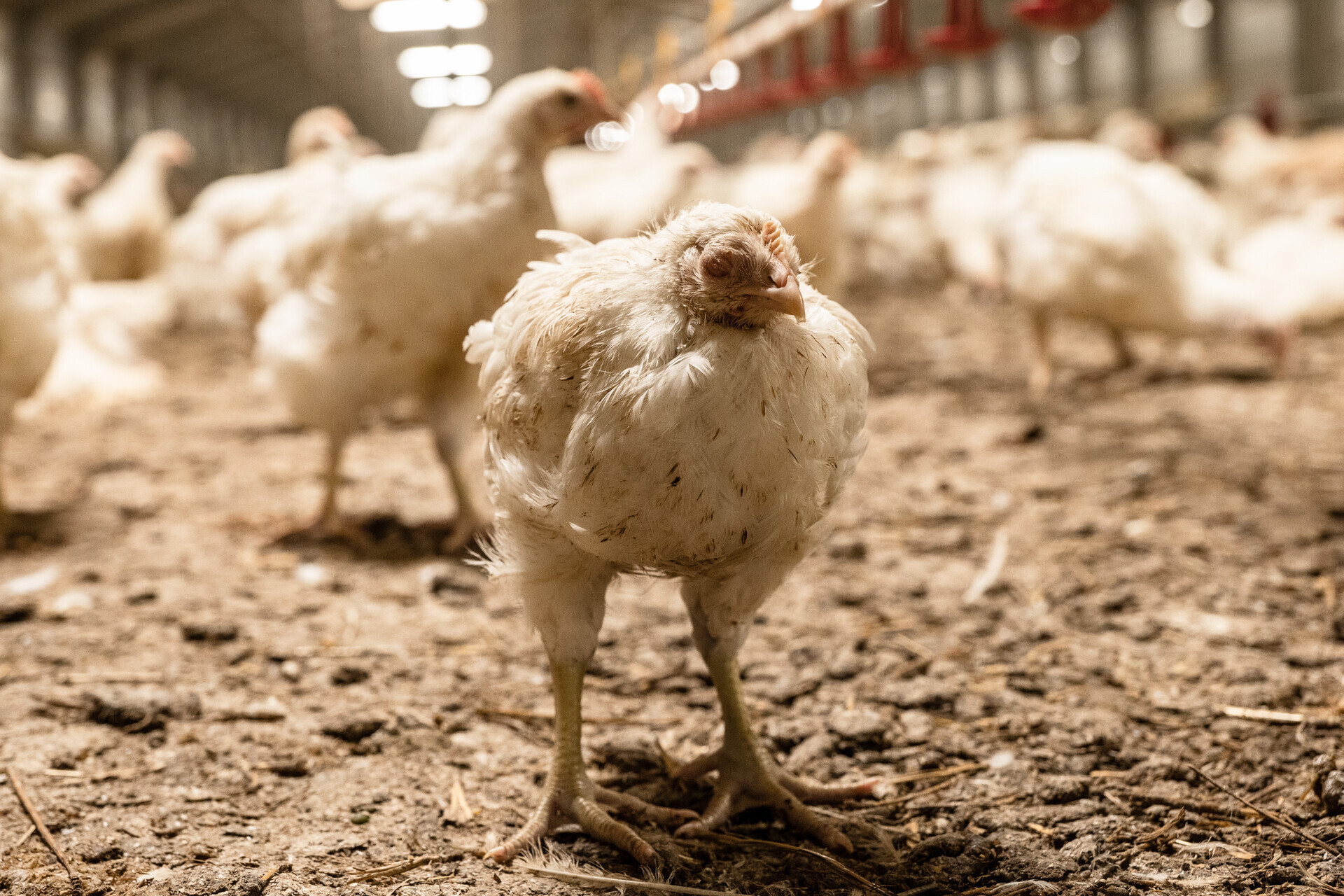
Animal health depends on their species. What lies behind meat consumption?
There are precise motivations underlying speciesism, “the belief,” according to the Treccani dictionary, “that human beings are superior in status and value to other animals, and therefore must enjoy greater rights.” Because of this, it is very difficult to feel interest or concern for the well-being of species considered inferior, which are often exploited and abused. If one looks at how most people in Italy regard animals, it becomes clear that so-called companion animals, although still seen as of lesser value than humans, enjoy significant privileges. As a rule, they live indoors, have food and water at will, and receive affection and attention. However, simply changing category of animal reveals the opposite. The affection felt for dogs and cats and the concern for their physical and mental health turns into indifference toward pigs, cows, rabbits, and chickens. In the same way, the psychological and cognitive nuances that can be observed in the former disappear in the latter. These individuals are not granted identity or personality. They are all the same, all destined to become products. Yet, even awareness of this distinction is not necessarily enough for an omnivorous person to change their lifestyle.
The concept that more than any other captures this inconsistency is the meat paradox. The Meat Paradox, Omnivore’s Akrasia, and Animal Ethics, a 2019 study edited by Elisa Aaltola, explains the meaning of akrasia, the “weakness of will” already discussed by Plato, meaning the tendency to act against what one considers the better choice. The author refers more specifically to “omnivore’s akrasia” as a state in which a person, aware that the consumption of animal products is “morally indefensible,” nevertheless continues to eat them. This may occur because the hedonic pleasure derived from eating meat, combined with habit and familiarity with certain recipes and rituals, reduces awareness of the paradox. These factors may also intersect with cognitive dissonance, namely the denial that meat comes from living beings, as if product and animal became two separate entities. This dissociation, as Aaltola suggests, is reinforced by marketing, which tends to avoid any reference to living animals and instead shows already portioned bodies ready for consumption, as is the case with most foods.
As a result, presenting an animal as a dish or ingredient significantly lowers the moral effort required to remain consistent with one’s values, because even the concept of the animal disappears. This phenomenon is well described by Carol J. Adams in The Sexual Politics of Meat, where she refers to the animal as the “absent referent.”
As clarified by Lorenza Bianchi, Head of Farmed Animals Area at LAV and Chair of the Eurogroup for Animals Farm Animal Working Group, “we observe a difference between the general sensitivity felt toward animals we know more closely, such as dogs or cats, and animals far from our eyes, from which it is easier to distance ourselves. It is a rejection of reality that allows people not to change their habits and not to question themselves. Moreover, the narrative around farmed animals, which uses collective terms such as livestock and poultry, completely depersonalizes them and hinders their perception as the individuals they are.”
Sensible beings, therefore, to whom identity and basic rights are denied. Speciesism is often justified by the claim that the consumption of meat, fish, and animal products is a biologically rooted human behavior. However, it should be noted that over time this practice has generated enormous business industries that were once almost nonexistent. If until the post–World War II period the average Italian diet consisted largely of cereals, vegetables, and legumes, it was from the 1960s onward that growing economic prosperity allowed more and more people to purchase meat and fish, once considered food for the wealthy classes. With increasing demand, production had to adapt and, also thanks to substantial state and EU subsidies, animal husbandry expanded and large industrial farms replaced small-scale breeders. The minimal welfare standards that could once be ensured on traditional farms have become almost a mirage for the many animals confined in modern industrial systems, despite existing regulations.
Funding that still favors large agribusiness groups has encouraged the creation of overcrowded facilities, environments that hardly allow proper movement for animals and that can become hotspots for serious infectious diseases. Recent news reports have documented outbreaks of African swine fever, whose eradication often involves mass culling.
Fortunately, the issue of animal welfare is becoming increasingly central in public debate, and various studies show that consumers of animal products are also influenced by this factor at the time of purchase. The study Farm Animal Welfare: Consumers’ Perception Toward Different Breeds of Animals in Italy, conducted by the University of Milan and published in 2025, investigated perceptions of farm animal welfare. It suggests that these perceptions vary according to socio-cultural and personal traits; in particular, more empathetic individuals tend to evaluate animal welfare more positively, especially for cattle and pigs, often symbolically associated with less intensive systems due to the imagery of open pastures. In contrast, chickens, sheep, and goats receive slightly lower evaluations, likely due to lower empathy or a less clear perception of their farming conditions. In light of these considerations, the study concludes that a utilitarian worldview prevails, reflecting so-called moral disengagement, through which individuals justify the use of animals to satisfy their needs.
Respect for animals therefore seems to depend on empathy and perception of each species, shaped by personal experience, cultural background, and media influence. What may foster the recognition of animals as sentient beings, Bianchi continues, is “knowing the reality of how the livestock industry works and engaging with animals in contexts where they are truly free to express themselves, such as sanctuaries and refuges. This would allow people to recognize emotions in them that are similar to our own.”