
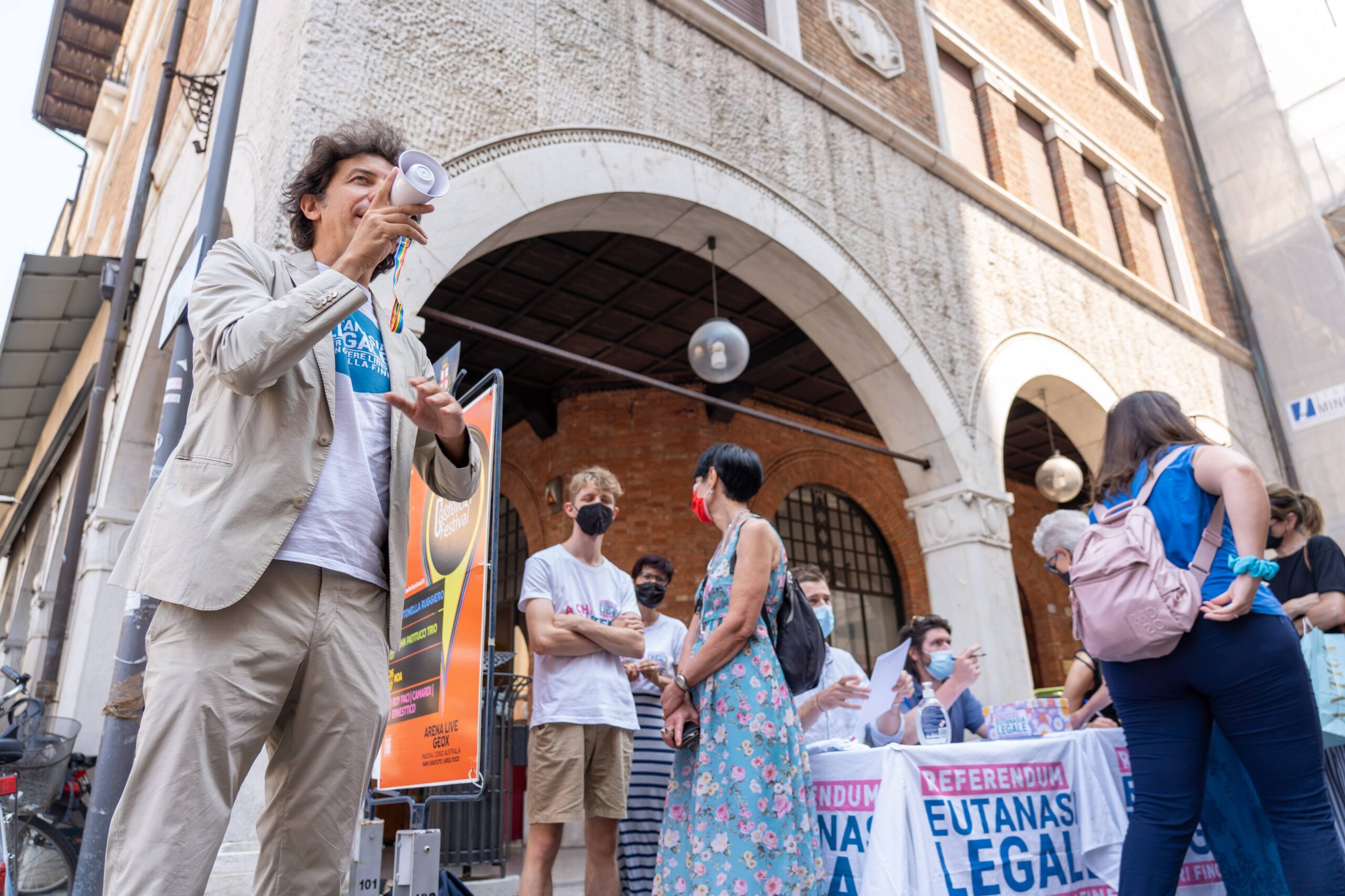
End of life and rights: the campaigns of the Associazione Luca Coscioni
Human rights, the removal of architectural barriers, access to medical cannabis, medically assisted procreation, and—of course—euthanasia and end-of-life issues. For more than 20 years, the Associazione Luca Coscioni, founded by the Radical Party leader who suffered from ALS and from whom it takes its name, has been fighting for civil liberties and self-determination through awareness campaigns, citizen-led legislative proposals, and acts of civil disobedience.
“Ideology consists in wanting to impose a model of life and society, forcing people to adapt, if necessary through coercion,” Marco Cappato, today the organization’s best-known figure, explains to DiverCity. “The Associazione Luca Coscioni follows the opposite method: it starts from the needs of life, health, and well-being that people freely express, and then identifies the obstacles that prevent them from being met. At that point, we put ourselves at their service to help remove those obstacles, when it can be done without harming others. The help does not consist in imposing certain actions, or in claiming to represent people politically, but in providing them with tools—informational, legal, and instruments of popular initiative—to assert their fundamental rights and freedoms.”
However, it is difficult to talk about the Associazione Luca Coscioni without immediately thinking of euthanasia and assisted suicide, issues at the center of a bill presented last July by the governing majority and currently stalled in Parliament. “On end-of-life issues, from the case of Piergiorgio Welby to today, we have managed to achieve the legalization of assistance in voluntary death in Italy under certain conditions, also thanks to civil disobedience in accompanying DJ Fabo to Switzerland,” Cappato explains. “We also contributed to the approval of the living will law and regional assisted suicide laws in Tuscany and Sardinia.”
Starting from the case of Fabiano Antoniani (known as DJ Fabo), accompanied to Switzerland to access assisted suicide by Cappato himself—who later turned himself in—the Constitutional Court established the conditions under which assisting someone in ending their life is not punishable, in Judgment 242 of 2019. This ruling, also known as the “Cappato Judgment,” established that assistance in suicide is not punishable when the person is fully capable of making free and informed decisions, is kept alive by life-sustaining treatments, suffers from an irreversible condition, and experiences intolerable suffering.
According to the Associazione Luca Coscioni, however, the bill currently under discussion represents a step backward compared to what the Constitutional Court established and effectively changes its parameters. The text affirms the principle of life as an “inviolable and inalienable right” and excludes people who depend on assistance from family members and caregivers, admitting only those “dependent on life-sustaining treatments.” It also introduces mandatory inclusion in palliative care pathways as a condition of access, prior involvement of judicial authorities, and the creation of a national ethics committee appointed by the government to centralize responses to assisted dying requests. Moreover, among the most contested points is the role of the National Health Service, which under the bill would not be allowed to provide this service.
The debate on end-of-life issues reopened in early April with the announcement of a new case of medically assisted death provided by the National Health Service to a person residing in Lombardy. This sparked renewed national mobilization calling for “the definitive withdrawal of a text that weakens already recognized rights.” The association commented: “If the government’s bill had already been in force, the person who received assistance in Lombardy would have been denied it, as would the other fourteen people who have so far been assisted in dying.”
How deeply this issue resonates among the Italian population is shown by the many calls received by the helpline 0699313409. In one year, the association received 16,000 requests for information on end-of-life issues, averaging 44 per day, of which five concerned euthanasia and assisted suicide specifically. Among other areas of activity is assisted reproduction, on which, the treasurer notes, “we have managed to abolish some of the discriminatory bans in Law 40, such as those on genetic testing and the limit of three embryos for implantation.” Important progress has also been made on the rights of people with illnesses and disabilities, another key area of activism: “Through legal action we have achieved—and continue to achieve—significant victories against discrimination and for the removal of architectural barriers,” Cappato concludes. “We also obtained, thanks to a Constitutional Court ruling, the possibility of signing electoral lists digitally, because not allowing it was discriminatory against people with severe disabilities.”